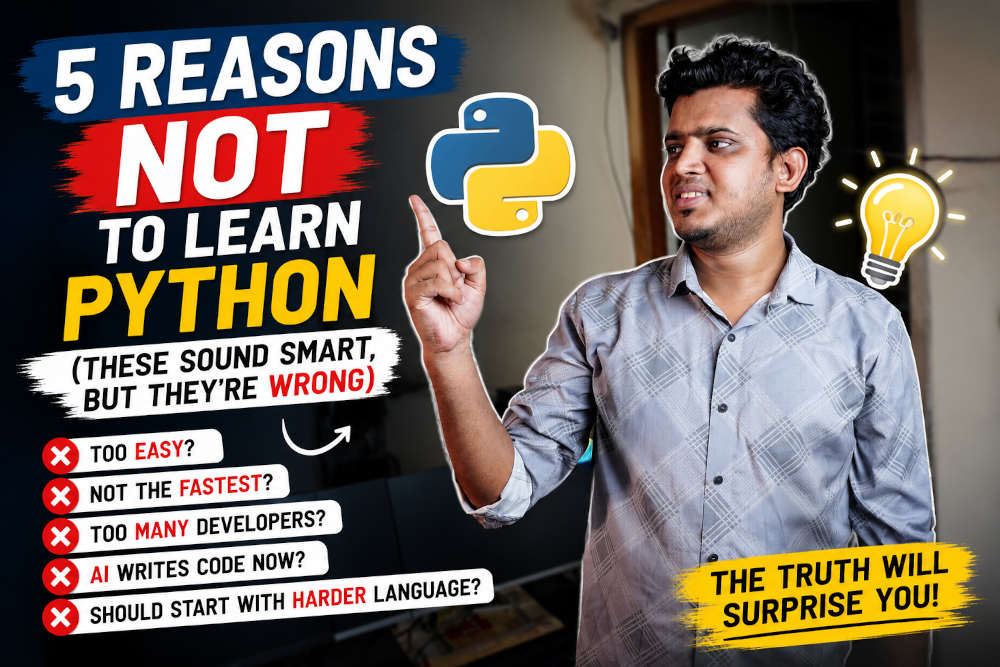
If you've spent any time online looking for programming advice, you've probably seen people arguing about Python.
Some say it's too easy.
Others say it's too slow.
Some even claim that AI will replace Python developers, so there's no point learning it anymore.
At first, these arguments sound reasonable.
But once you understand how software development actually works, you'll realize that most of these are misconceptions.
In this article, we'll go through five common reasons people avoid learning Python and explain why they don't hold up in the real world.
Whether you're completely new to programming or trying to choose your first language, this guide will help you make a more informed decision.
Why Python Became So Popular
Before addressing the myths, let's answer one important question:
Why does everyone recommend Python?
The answer isn't because it's the "best" programming language.
It's because Python removes many of the unnecessary difficulties that beginners face.
Instead of fighting with complicated syntax, you can focus on learning what programming is really about:
Solving problems
Thinking logically
Breaking large problems into smaller ones
Writing clean, readable code
That's why Python is widely used in:
Web development
Artificial Intelligence (AI)
Machine Learning
Automation
Data Science
Cybersecurity
Game development
Scripting
APIs
Cloud computing
The language itself isn't magical.
It simply lets developers become productive quickly.
Reason #1: "Python Is Too Easy. Nobody Pays for Easy Code."
This is probably the biggest misunderstanding about programming.
Many beginners assume that difficult programming languages automatically lead to higher salaries.
That's not how companies think.
What Companies Actually Pay For
Businesses don't make money because developers write complicated code.
They make money because developers solve expensive business problems.
Imagine two developers.
Developer A spends three weeks writing an extremely complicated solution.
Developer B solves the exact same problem in three days using Python.
Which developer saved the company more time and money?
Almost always, it's Developer B.
Companies care about results.
Not difficulty.
Why Python Helps
Python has a clean and readable syntax.
For example:
numbers = [1, 2, 3, 4, 5]
squared = [n ** 2 for n in numbers]
print(squared)
Even if you've never written Python before, you can probably guess what's happening.
The code:
Creates a list of numbers
Squares every number
Prints the result
The syntax stays out of your way.
That means you spend more time solving problems and less time fighting the language.
Real-World Example
Imagine your manager asks you to create a script that automatically organizes thousands of files.
With Python, this could take less than an hour.
That one script might save your company hundreds of hours every year.
That's valuable.
Nobody cares whether the script looked "hard."
Common Mistake
Many beginners chase difficult languages because they believe complexity equals intelligence.
In reality:
Good developers write simple code that other developers can understand.
Simple code is easier to maintain, debug, and improve.
Reason #2: "Python Isn't Fast"
This statement is technically true.
Python is generally slower than languages like C, C++, or Rust for raw execution speed.
But this doesn't automatically make Python a bad choice.
Why Speed Isn't Everything
Think about vehicles.
A sports car is faster than a pickup truck.
But if you're moving furniture, you wouldn't choose the sports car.
Different tools solve different problems.
Programming languages work the same way.
Developer Time vs Computer Time
There's an important concept every programmer should understand.
Developer Time
This is the time it takes you to:
Design a solution
Write code
Test it
Fix bugs
Maintain it
CPU Time
This is the time your computer needs to run the program.
For many business applications, developer time is much more expensive than CPU time.
Saving a developer five days is often worth far more than saving a server five milliseconds.
Why Companies Choose Python Anyway
Many successful companies use Python because it allows teams to build software quickly.
Even if a specific part becomes too slow later, developers can optimize only that section using faster languages.
This gives them the best of both worlds.
Practical Example
Suppose you're creating:
A website
A REST API
A Discord bot
A data analysis script
An automation tool
In these situations, Python's speed is usually more than enough.
The users won't notice a difference.
But you'll finish development much faster.
Best Practice
Don't optimize performance before you actually have a performance problem.
This is called premature optimization, and it's one of the most common mistakes beginners make.
Build first.
Measure performance.
Optimize only where necessary.
Reason #3: "There Are Already Millions of Python Developers"
Many people believe that more developers automatically mean fewer opportunities.
That sounds logical.
But the real world works differently.
Think About English
Millions of people speak English.
Does that mean English is useless?
Of course not.
The large number of English speakers exists because the language is useful.
Python follows the same pattern.
Large communities usually exist because demand is high.
Not because opportunities disappeared.
Why Large Communities Are Actually Good
A huge Python community means:
Better tutorials
More YouTube videos
More Stack Overflow answers
Better documentation
More open-source libraries
Faster bug fixes
More learning resources
Instead of competing with millions of developers...
You're learning alongside millions of developers.
Practical Example
Suppose you're building a website and need user authentication.
Instead of writing everything yourself, Python frameworks already provide secure authentication systems.
That saves weeks of work.
Beginner Tip
Don't worry about competition.
Instead, focus on becoming better than your past self every month.
Consistency beats comparison.
Reason #4: "AI Writes Code Now. Why Learn Programming?"
This is one of the newest arguments.
Since tools like ChatGPT and GitHub Copilot can generate code, some people think programming is becoming unnecessary.
The reality is much more interesting.
AI Is a Tool
AI doesn't magically know what your application needs.
It predicts code based on your instructions.
If your instructions are poor...
The output will usually be poor too.
Why Programming Still Matters
Imagine asking an architect AI to design a house.
If you know nothing about construction, how will you know whether the design is safe?
Programming works the same way.
If AI generates incorrect code:
Can you identify the bug?
Can you improve the solution?
Can you make it secure?
Can you maintain it six months later?
Without programming knowledge, that's extremely difficult.
AI Makes Good Developers Faster
Experienced developers use AI to:
Generate boilerplate code
Write documentation
Refactor functions
Find bugs
Explain unfamiliar code
Brainstorm solutions
Notice something?
The developer is still making the decisions.
AI simply removes repetitive work.
Best Practice
Learn programming first.
Then learn how to use AI effectively.
Together, they become an incredibly powerful combination.
Reason #5: "I Should Start with a Harder Language"
Some beginners believe suffering through a difficult language will make them stronger programmers.
This is another common myth.
Programming Isn't About Syntax
Programming is fundamentally about solving problems.
The language is just a communication tool.
For example:
Imagine learning mathematics.
Would you start by memorizing every scientific calculator?
Probably not.
You'd first learn:
Addition
Subtraction
Logic
Patterns
Problem solving
Programming is no different.
Why Python Is Great for Beginners
Python removes unnecessary syntax so you can focus on:
Variables
Loops
Functions
Conditions
Algorithms
Data structures
Object-oriented programming
These concepts transfer to almost every other programming language.
Once you understand programming itself, learning another language becomes much easier.
Example
Someone who understands Python well can usually learn JavaScript, Java, Go, or C# much faster than someone who memorized syntax without understanding programming concepts.
The skill transfers.
The syntax changes.
Common Beginner Mistake
Many people spend months comparing programming languages instead of actually building projects.
Don't fall into that trap.
Pick one language.
Learn it well.
Build real projects.
You'll grow much faster.
So... Should You Learn Python?
Python isn't perfect.
No programming language is.
Every language has strengths and weaknesses.
But Python continues to be one of the best choices for beginners because it helps you learn programming without unnecessary frustration.
Its popularity isn't an accident.
It's the result of decades of developers choosing productivity over unnecessary complexity.
If your goal is to build useful software, automate repetitive tasks, explore AI, analyze data, or simply become a better programmer, Python is an excellent place to start.
Summary
Many reasons people give for avoiding Python sound convincing at first.
But once you understand how software development works, they begin to fall apart.
Companies don't pay for complicated code.
They pay for valuable solutions.
Python may not be the fastest language, but it often helps developers deliver projects much faster.
A large community creates better learning resources, not fewer opportunities.
AI isn't replacing programmers—it is becoming one of the most useful tools programmers have.
And finally, becoming a great developer has far more to do with learning problem-solving than learning difficult syntax.
Key Takeaways
✅ Companies value problem-solving more than complicated code.
✅ Python helps developers build software quickly and efficiently.
✅ Developer productivity often matters more than raw execution speed.
✅ A large Python community means more resources and better support.
✅ AI enhances programmers rather than replacing them.
✅ Programming is about logical thinking, not memorizing syntax.
✅ Building projects is more important than endlessly comparing languages.
What's Next?
If you've decided to start learning Python, here's a practical learning roadmap:
Learn the basics
Variables
Data types
Input and output
Operators
Master control flow
ifstatementsLoops
Pattern recognition
Problem solving
Understand functions
Creating reusable code
Parameters
Return values
Scope
Work with data structures
Lists
Tuples
Dictionaries
Sets
Learn Object-Oriented Programming (OOP)
Classes
Objects
Inheritance
Encapsulation
Build real projects
Calculator
To-do application
File organizer
Web scraper
REST API
Discord bot
Automation scripts
Explore a specialization
Web Development with Django or Flask
Data Science with Pandas and NumPy
Machine Learning with Scikit-learn
AI with TensorFlow or PyTorch
Automation and scripting
Cybersecurity tools
The best way to become a Python developer isn't by debating whether Python is worth learning.
It's by writing your first line of code, then your second, and continuing to build projects that solve real problems.