There’s a strange truth in web development that nobody talks about enough:
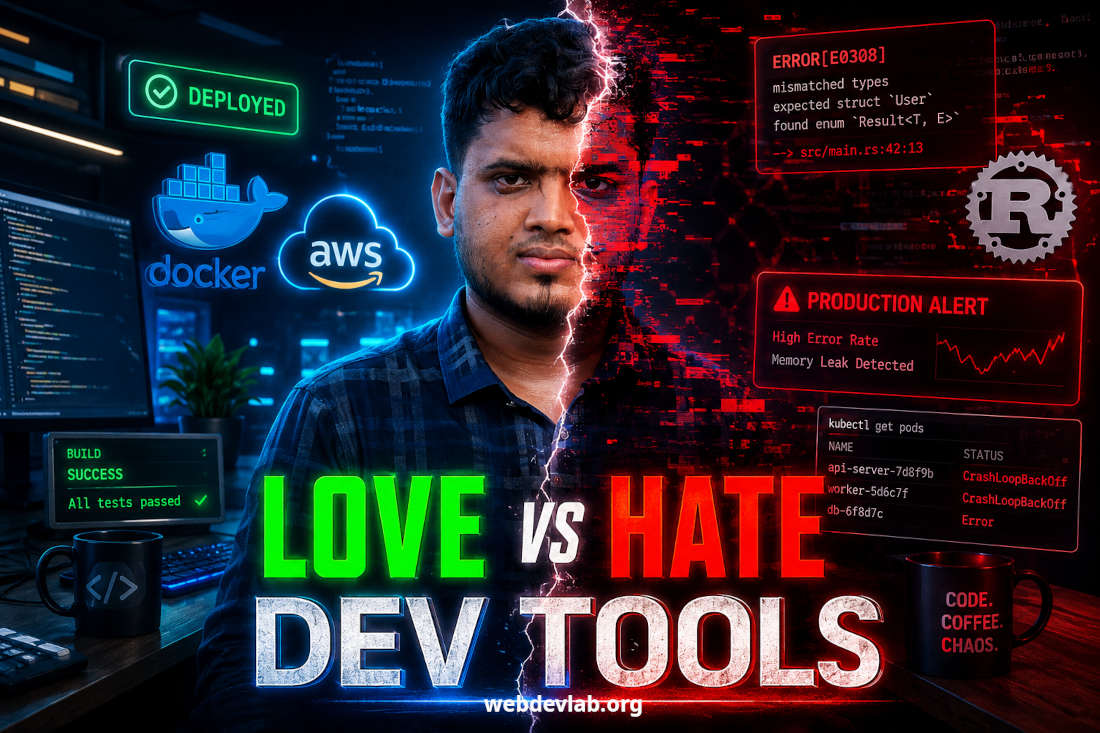
The tools you love the most… are usually the ones that frustrate you the most too.
One day you’re saying “this is genius”, and the next day you’re staring at your terminal thinking “why is this even a thing?”
If you’ve ever worked in web development, backend systems, DevOps, or AI integration, you already know this feeling.
Let’s talk about the tools that live in that weird emotional middle ground — loved, hated, and somehow still essential.
And yes… this connects directly to what many “vibe coders” eventually discover the hard way.
1. Docker: The “It Works on My Machine” Fix That Breaks Your Brain
Docker is one of those tools that feels magical… until it doesn’t.
At first, it solves everything:
environment issues disappear
deployment becomes clean
teamwork feels smooth
Then suddenly:
container networking breaks
volumes behave strangely
builds fail for “no reason”
and you spend 3 hours debugging a 2-line config mistake
In real-world DevOps and backend web development, Docker is both:
a productivity booster
and a mental endurance test
You love it because it saves projects.
You hate it because it silently punishes small mistakes.
Still… you can’t avoid it. It’s everywhere in modern system design.
2. AWS Console: Powerful, But Emotionally Confusing
AWS is like a massive city.
Everything you need exists somewhere inside it… but good luck finding it.
You’ll open the console for something simple like:
S3 bucket config
EC2 deployment
IAM permissions
And suddenly you're lost in 12 tabs wondering how you got there.
In cloud computing and backend systems, AWS is unmatched in power.
But emotionally?
It feels like:
“I know this is important… but I also feel slightly attacked.”
Still, every scalable system eventually ends up here.
3. Rust: The Language You Respect But Fear a Little
Rust developers will tell you:
“It prevents memory bugs and gives safety.”
And they’re right.
But learning Rust feels like:
your brain is being upgraded
while also being constantly tested
It’s strict. Very strict.
For many web developers used to JavaScript or Python, Rust feels like:
discipline training for code
with zero tolerance for shortcuts
You love it because it builds high-performance systems.
You hate it because it refuses to let you cheat.
Still, in system design and performance-critical backend services, Rust is becoming unavoidable.
4. Smart Contracts: Simple Idea, Complex Reality
On paper, smart contracts sound clean:
“Code that runs itself on blockchain.”
In reality?
It’s more like:
tiny mistakes = expensive disasters
debugging is painful
deployment is permanent
In blockchain development and Web3 systems, smart contracts are powerful but unforgiving.
You don’t “fix later.”
You get it right the first time… or pay for it.
That pressure alone makes developers both admire and avoid them.
5. Payment Integration: The Silent Stress Generator
Nothing tests a developer like payments.
You think it’s simple:
user pays
system confirms
done
But real life says otherwise:
webhook failures
currency edge cases
failed transactions
duplicate charges fear
security requirements everywhere
In backend web development, payment systems are where “simple apps” become “serious systems.”
You love it because it means real business logic.
You hate it because:
one small bug can cost real money.
6. Debugging Production Issues: The Ultimate Emotional Rollercoaster
This is where every developer becomes fully human again.
Everything is fine in local:
tests pass
logs look clean
confidence is high
Then production breaks.
And suddenly:
users are affected
logs don’t help much
reproduction is impossible
and time slows down
This is where real software engineering begins.
You learn more from production bugs than from any tutorial on web development, AI systems, or system design.
But emotionally?
It’s pure chaos.
Still… fixing it feels like victory.
7. Smart Toolchains (AI Tools + Dev Assistants): Helpful, But Not Perfect
Modern AI tools are amazing:
faster coding
autocomplete magic
quick prototypes
But they also create a new problem:
“It looks correct… but is it actually correct?”
In AI-assisted web development, this is becoming a daily question.
You love AI because it speeds everything up.
You hate it because it can confidently be wrong.
It’s the newest entry in the “love and hate” category — and it’s evolving fast.
So… Did We Miss Anything?
Probably yes.
Because every developer has their own “love-hate” tool list.
Some common additions might be:
Kubernetes (powerful but complex)
Git merge conflicts (pure emotional damage)
CI/CD pipelines (amazing until they fail at 2 AM)
Linux servers (simple… until permissions break everything)
The truth is:
The more powerful the tool, the more emotional your relationship with it becomes.
Final Thoughts
Being a developer isn’t just about writing code.
It’s about:
managing complexity
solving unpredictable systems
and building patience with tools that sometimes fight back
Whether you’re into web development, backend engineering, DevOps, AI, or system design, you’ll always have a few tools you love and hate at the same time.
And strangely… that’s what makes the job interesting.
Because if everything was easy, it wouldn’t feel like engineering.