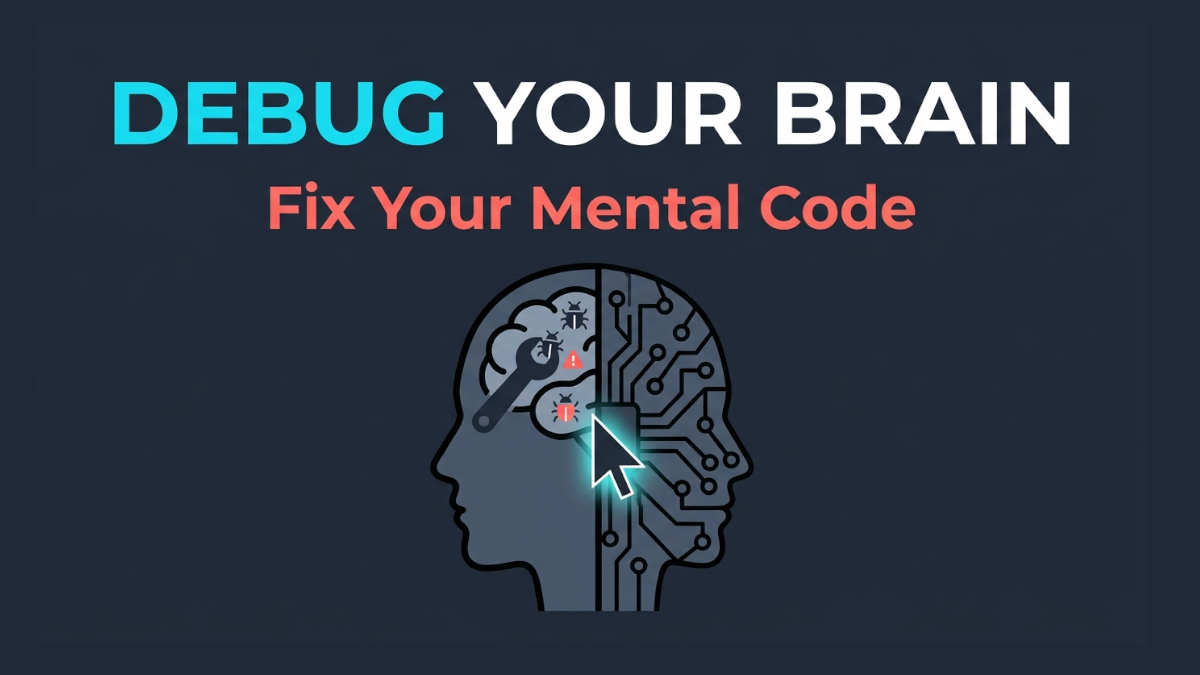
You trust your brain to write logic, solve algorithms, and architect systems. But here is the scary truth: your brain is running legacy code.
It has bugs. It takes shortcuts. It sends false error messages.
In psychology, these bugs are called Cognitive Distortions. They are automatic thinking patterns your brain runs on repeat.
They helped our ancestors survive tiger attacks. Today, they cause you to freeze during a production outage, get angry in a code review, or feel like an imposter when you look at a senior developer's code.
The first step to fixing a bug is reproducing it. The first step to fixing your thinking is spotting the pattern.
Here are 12 of the most common "logic errors" I see in developers (and in myself), and how to patch them.
1. Mind Reading (The undefined Variable)
The Bug: Assuming you know what others are thinking without checking the source of truth.
"My team lead hasn't replied to my Slack message. She must think my pull request is terrible."
"The junior dev asked a question. He probably thinks I'm a bad mentor."
Why we do this: Our brains hate null values. When we lack information (why hasn't she replied?), we fill the gap with a worst-case scenario to feel a sense of control.
The Fix (Ask for the API):
In programming, you wouldn't guess the value of a variable; you would console.log() it. Do the same with people.
❌ Assumption: "They hate my code."
✅ Reality Check: "Hey, I noticed you haven't commented on the PR yet. I'm eager to merge, is there anything you want me to change first?"
Best Practice: Treat human communication like an API request. You need a response to know the status code. You cannot read the server's mind.
2. Negative Focus (The Filter Function)
The Bug: You ship a feature, but one user reports a minor UI glitch. You ignore the 99% of positive feedback and obsess over the single bug.
"My presentation was good, but I stuttered on the second slide. It was a disaster."
Why we do this: From an evolutionary standpoint, noticing the danger (the tiger) was more important than noticing the flowers. But in code review, filtering for only the negative destroys your morale.
The Fix (Write a Log):
Your brain has a "negativity bias" filter active by default.
✅ Before bed, write down three things that went well today.
✅ Did you finally fix that memory leak? Write it down.
✅ Did you help a teammate? Write it down.
Best Practice: When reviewing your own performance, force yourself to run a "Positive Query" before you run the "Bug Query."
3. Catastrophizing (The Fatal Error)
The Bug: Expecting the worst-case scenario to happen.
"If this deploy fails, the whole company will lose money, I will get fired, and I'll lose my apartment."
Why we do this: It’s the mental equivalent of throwing an exception and catching it globally. We prepare for the apocalypse so we aren't surprised. But it causes paralyzing anxiety.
The Fix (Probability Check):
Ask yourself: What is the most likely outcome?
❌ Worst case (0.1% chance): Fired and homeless.
✅ Most likely case: The build fails, you roll back, you fix the typo, and you go home.
Common Mistake: Confusing "possibility" with "probability." Just because a server can catch fire doesn't mean it will.
4. Labeling (The Hard-Coded String)
The Bug: Assigning a permanent, negative label to yourself or others based on one action.
"I missed that deadline. I'm a lazy developer."
"He wrote that spaghetti code. He's an idiot."
Why we do this: Labels are shortcuts. It takes mental energy to analyze context. It is easier to say "I am a failure" than to say "I underestimated the scope of this specific ticket."
The Fix (Refactor the Class):
Labels are permanent. Behavior is situational.
✅ Replace "I am lazy" with "I didn't prioritize that task well this sprint."
✅ Replace "He is a bad coder" with "That specific module he wrote lacks test coverage."
Best Practice: Don't make a temporary bug a permanent identity.
5. Should-Thinking (The Unnecessary Dependency)
The Bug: Having rigid rules about how you or the world should be.
"I should know how to use Kubernetes by now."
"The project manager should always write clearer tickets."
Why we do this: We install rigid dependencies in our minds. When reality doesn't match the dependency, the app crashes.
The Fix (Loose Coupling):
Change your "Should" statements to "Could" or "It would be nice if."
❌ "I should be a senior dev by now." (Causes guilt)
✅ "I could learn this skill to become a senior dev." (Creates opportunity)
Best Practice: Code is flexible. Humans are flexible. Don't trap yourself in a rigid box.
6. Overgeneralizing (The Infinite Loop)
The Bug: Believing a single negative event is a pattern.
"I failed that technical interview. I will never get a job as a developer."
"This bug took me 3 days to fix. I'm bad at programming."
Why we do this: The brain is lazy. It prefers a single, simple rule ("I always fail") over complex data analysis.
The Fix (Break the Loop):
Look for exceptions.
✅ Evidence against: "Actually, I passed two other interviews last year. This one was just harder."
✅ Counter-example: "I fixed a hundred bugs quickly before; this one was just complex."
Common Mistake: Using words like "Always," "Never," and "Every time." These are usually false.
7. Emotional Reasoning (The False Positive)
The Bug: Believing that how you feel is equal to reality.
"I feel stupid reading this codebase, therefore I am stupid."
"I feel anxious about this release, so something must be wrong with it."
Why we do this: Your emotions are generated by your hormones and past trauma, not necessarily by the current code on the screen.
The Fix (Unit Test Your Feelings):
Separate the feeling from the fact.
✅ Fact: "This codebase is new to me."
❌ Feeling: "I am dumb."
✅ Evidence: "I am dumb" is not a valid data type. The codebase is complex. That is the fact.
Best Practice: Treat feelings like compiler warnings, they indicate something is happening, but they don't always stop the build.
8. Fortune-Telling (The Bad Prediction)
The Bug: Thinking the future is set and you know what it is (usually a bad one).
"My talk at the meetup is going to be embarrassing."
"This PR will be rejected."
Why we do this: We fear uncertainty. By predicting a negative outcome, we feel "prepared" for the pain.
The Fix (Update the Roadmap):
Remind yourself that you cannot access the Future API.
✅ "I might stutter, or I might nail it. I don't know until I run the script."
Best Practice: Don't debug code that hasn't been written yet.
9. Personalization (The Memory Leak)
The Bug: Feeling responsible for things you can't control.
"The client changed the requirements and we missed the deadline. It's my fault."
"The server crashed because of an AWS outage. I should have prevented it."
Why we do this: It gives us a feeling of power. If it is "our fault," it means we had control, and we can fix it next time.
The Fix (Scope Management):
Ask yourself: What is actually within my control?
✅ You control: Your code quality, your tests, your communication.
❌ You don't control: Traffic spikes, third-party API failures, the economy.
Best Practice: Take responsibility for your code, not for the infrastructure of the universe.
10. Owning the Truth (The Confirmation Bias)
The Bug: Being certain you are right and your opinion is the objective truth.
"React is better than Vue."
"This architecture is garbage."
Why we do this: If our opinions are "Truth," it means we are smart and safe. Admitting we are wrong hurts our ego.
The Fix (Open a Discussion):
Get curious about other perspectives.
✅ "That's interesting you use Vue. Why did you choose that for this project? I prefer React because of the ecosystem."
✅ "I see you structured the folders this way. I don't understand it yet, but I want to learn why."
Best Practice: You are a developer; you are a professional learner. You don't know everything.
11. Just-World Thinking (The Perfect Algorithm)
The Bug: Assuming that everything will be balanced fairly.
"I worked hard on this code, so the client should love it."
"I'm a good person, so I shouldn't be laid off."
Why we do this: We want to believe the system is a deterministic, fair function. But the world is not a pure function; it has side effects.
The Fix (Accept the Real World):
Accept that life isn't always fair and focus on what you can influence.
✅ "I wrote great code. The client may not appreciate the technical elegance, but I can influence how I present the value."
Best Practice: Don't expect the compiler to give you a gold star just because you wrote a clean loop.
12. Control Fallacy (The God Object)
The Bug: Assuming you can control everything in your life.
"If I just work harder, I can make this deadline." (Even though 3 other teams are blocking you.)
"I need to control how everyone writes their commit messages."
Why we do this: Micromanaging feels productive.
The Fix (Implement Interfaces):
Practice letting go of things outside your control and focus your energy wisely.
✅ Let go: What other people think, how other people code, market conditions.
✅ Control: Your reaction, your effort, your boundaries.
Conclusion: Your Thoughts Aren't Facts
In coding, there is a difference between a Source Map and the Reality.
The Source Map is your brain. It tries its best to map reality, but often points to the wrong line.
When you feel anxious, stuck, or angry, try running git log on your thoughts.
Look at the thought.
Identify which of the 12 bugs above it belongs to.
Apply the specific "fix" (the refactor).
Learning to spot these patterns is the first step to thinking more clearly and shipping faster.
Which one do you catch yourself doing most? (I personally fall into the "Catastrophizing" trap every time I merge to main on a Friday).
Let me know in the comments below.