AI systems used to answer questions are becoming easy to build. The harder problem is building AI systems that can decide what to do, use tools, remember context, respond to changing conditions, and actually complete a task.
That is where agentic AI comes in.
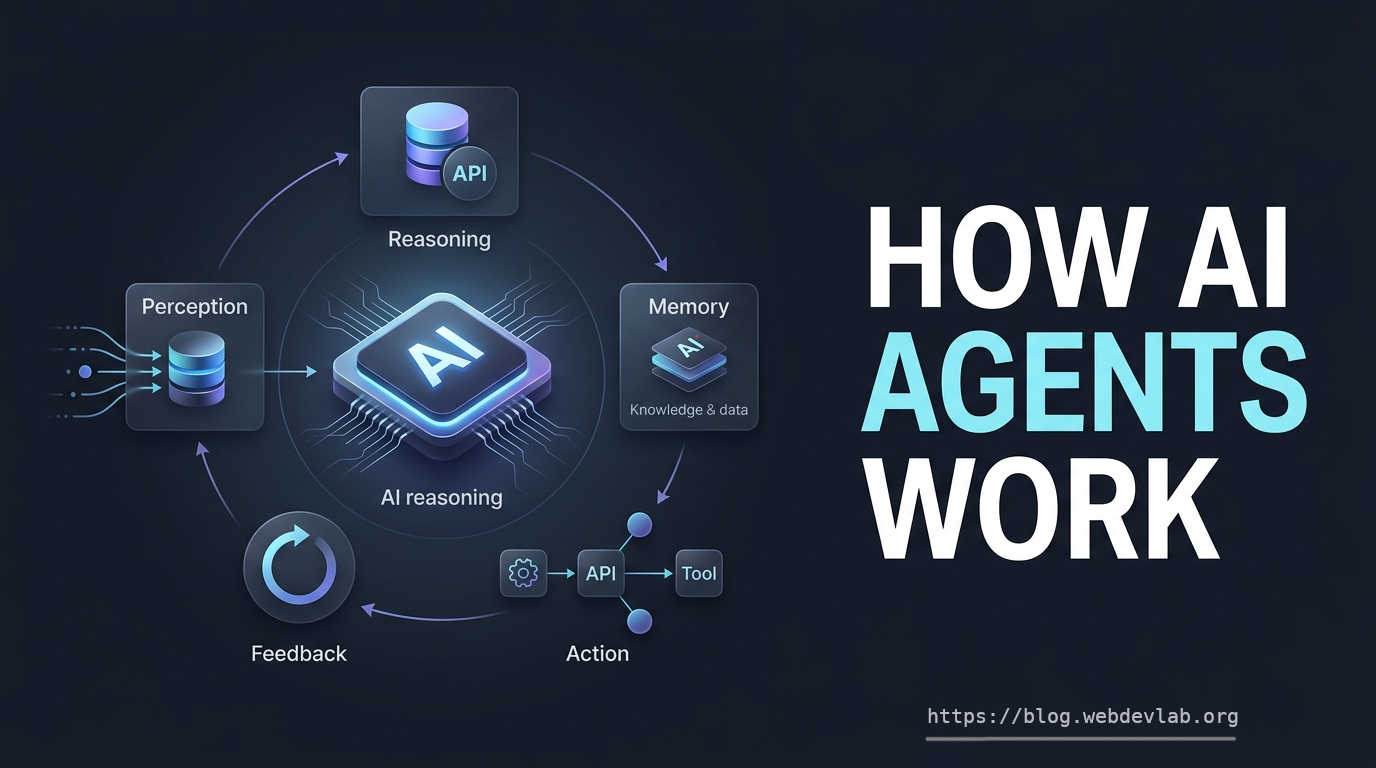
An agent might analyze sales data, query a database, call an API, update a CRM record, ask for additional information, and adjust its next action based on the result. It isn't simply generating text—it is participating in a continuous perception → reasoning → action → feedback loop.
But autonomy doesn't come from an LLM alone.
A production-ready agentic AI system needs several layers working together: a way to perceive its environment, a reasoning and planning engine, memory, tools for taking action, and feedback mechanisms that allow the system to evaluate results and continue.
This article breaks down those five core components of agentic AI systems, explains how they fit together, and examines the infrastructure and design decisions that matter when moving from an impressive demo to a production system.
Key takeaway: An LLM can provide intelligence, but an agentic system provides the surrounding machinery that turns intelligence into goal-directed action.
What Is Agentic AI?
Agentic AI refers to AI systems that can pursue goals, make decisions, use tools, and take actions with a degree of autonomy instead of simply responding to individual prompts.
A traditional chatbot typically follows:
User → Prompt → LLM → Response
An agentic system follows a more dynamic loop:
Goal → Perceive → Reason → Act → Observe → Adapt → Repeat
For example, if you ask:
"Analyze our Q3 sales performance and identify underperforming regions."
A basic LLM might explain how to perform the analysis. An agent could:
Find the relevant sales data
Query the database
Analyze regional trends
Detect anomalies
Retrieve additional information
Generate charts and a report
Recommend follow-up actions
The key difference isn't simply intelligence. Agentic AI combines the model with tools, memory, orchestration, state, and feedback loops, allowing it to move from generating answers to completing tasks.
The 5 Core Components of Agentic AI Systems
Production agentic systems can be understood through five major components:
Perception
Reasoning and planning
Memory
Action and execution
Feedback and learning
These components aren't isolated modules. They form a continuous loop.
Perception → Reasoning → Memory → Action → Feedback → Perception
Let's examine each one.
1. Perception: Giving the Agent a View of the World
Before an agent can make a useful decision, it needs information about what is happening around it.
The perception layer acts as the agent's sensory interface.
It collects raw information from sources such as:
APIs
Databases
Files
Applications
User messages
Event streams
Sensors
Knowledge bases
That information then needs to be transformed into structured context that the reasoning engine can understand.
Perception Is More Than Data Ingestion
A common mistake is assuming perception simply means collecting everything available.
Production agents need relevant information, not unlimited information.
Suppose a customer-support agent is handling a refund request.
It may need:
Customer identity
Order history
Payment status
Refund policy
Previous support conversations
It probably doesn't need every record in the company's database.
This is why modern agents increasingly use active perception.
Instead of processing everything upfront, the agent can determine what information it needs and retrieve it during execution.
For example:
Customer asks for a refund
        ↓
Agent identifies order number
        ↓
Retrieve order details
        ↓
Check refund policy
        ↓
Check payment status
        ↓
Decide next action
The reasoning process itself helps determine what the perception layer should retrieve next.
Retrieval and Context Assembly
Perception can involve several technical layers:
Data connectors
Retrieval systems
Embedding models
Vector search
Feature extraction
Context assembly
Event streaming
This is also where RAG-style architectures become important. Rather than expecting the model to know everything, the system retrieves relevant external information and supplies it as context.
A useful rule: Better perception often means better decisions—not necessarily a bigger model.
2. Reasoning and Planning: Turning Information Into Decisions
Once the agent understands its environment, it needs to decide what to do.
That's the responsibility of the reasoning and planning engine.
This is where LLMs and reasoning models become particularly valuable.
A production agent may need to:
Break a goal into smaller tasks
Decide which tool to use
Determine the order of operations
Evaluate intermediate results
Change its plan when something fails
Decide when it has enough information
Escalate to a human when necessary
ReAct: Reasoning + Acting
One important pattern is ReAct, short for Reasoning and Acting.
The basic loop looks like this:
Think
 ↓
Choose an action
 ↓
Use a tool
 ↓
Observe the result
 ↓
Think again
 ↓
Choose the next action
This is fundamentally different from a fixed workflow.
A conventional workflow might say:
Step 1 → Step 2 → Step 3 → Step 4A ReAct-style agent can instead say:
Step 1
  ↓
Result changes the situation
  ↓
Should I do Step 2 or something else?
  ↓
Choose dynamically
That flexibility is one of the defining characteristics of agentic systems.
Reasoning Is Not the Same as Autonomy
This distinction is easy to miss.
A model can reason extremely well without being an autonomous agent.
For example, a reasoning model might produce an excellent plan:
"Contact the customer, verify their account, check eligibility, and issue the refund."
But an agentic system can actually:
Find the customer.
Verify the account.
Check the policy.
Call the refund API.
Confirm the result.
Update the support ticket.
Reasoning determines what should happen. Tools and orchestration make it happen.
3. Memory: Giving Agents Context Across Time
There's a fundamental limitation in most LLMs:
They don't automatically remember everything that happened before.
An agent therefore needs explicit memory architecture if it must maintain context across multiple steps or sessions.
Memory becomes particularly important when agents operate over long-running workflows.
Imagine a customer-support agent that interacted with a customer last month. If the agent needs to know what happened during that conversation, that information must be stored somewhere and retrieved when relevant.
Short-Term Memory
Short-term memory contains the information needed for the current task.
This might include:
Recent messages
Current tool results
Intermediate decisions
Active workflow state
As conversations become longer, context windows can become expensive or unwieldy.
Systems therefore use techniques such as:
Context pruning
Summarization
Compaction
Relevance filtering
The goal isn't to remember everything.
It's to preserve what matters.
Long-Term and Semantic Memory
Long-term memory allows information to survive beyond a single session.
Semantic memory is particularly useful for retrieval-based systems.
For example:
User asks a question
       ↓
Search semantic memory
       ↓
Retrieve relevant knowledge
       ↓
Add context to prompt
       ↓
Generate response/action
Vector search can help locate information based on semantic similarity rather than exact keyword matches.
This makes memory architecture closely connected to RAG and vector databases.
Memory Can Matter More Than Prompt Engineering
One of the most important practical insights from production agent design is that performance isn't determined by the model alone.
An excellent model supplied with irrelevant context can still make poor decisions.
A slightly less capable model with high-quality retrieval, state management, and context selection can perform surprisingly well.
The question isn't simply "Which model should we use?" It's also "What information should the model see at each step?"
4. Action and Execution: Where AI Actually Does Something
This is the component that most clearly separates an agent from a system that only generates text.
The action and execution layer connects the agent's decisions to the outside world.
Typical tools include:
REST APIs
Databases
Search engines
Calculators
Payment systems
CRM platforms
Email services
Internal business applications
Code execution environments
Function Calling Is the Foundation
A model doesn't directly execute arbitrary business operations.
Instead, it can produce structured instructions describing which tool it wants to call and which parameters it wants to provide.
For example:
{
  "tool": "get_order",
  "parameters": {
    "orderId": "ORD-12345"
  }
}
The runtime validates the request and executes the corresponding function.
The result then returns to the agent:
LLM
 ↓
Tool selection
 ↓
Function call
 ↓
External system
 ↓
Tool result
 ↓
LLM
The agent can then determine its next action.
Tool Design Matters
Poorly designed tools can make even a capable model unreliable.
A tool should have a clear:
Name
Description
Parameter schema
Required fields
Validation rules
Permission model
Error behavior
For high-impact operations, additional safeguards are essential.
An agent should not be allowed to:
"Delete all customer records"
simply because a model generated a valid-looking function call.
Production systems need authorization, validation, audit logging, rate limits, approval gates, and clearly defined boundaries.
Common Orchestration Patterns
Agents can coordinate actions in different ways.
Sequential
A → B → C → DUse when each operation depends on the previous result.
Concurrent
     → A →
Start → B → Continue
     → C →
Use when several independent operations can run simultaneously.
Other approaches include:
Agent handoffs
Multi-agent collaboration
Coordinator-based architectures
Group-chat patterns
The choice should be driven by the workflow rather than by the popularity of a particular framework.
5. Feedback Loops: How Agents Adapt
An agent that takes actions but never evaluates the results is essentially running blind.
That's why feedback completes the agentic loop.
After an action is executed, the system should inspect the result and determine what happens next.
Perceive
   ↓
Reason
   ↓
Act
   ↓
Observe result
   ↓
Evaluate
   ↓
Next action
Feedback can come directly from the environment.
For example:
Agent calls payment API → API returns "insufficient funds" → agent changes strategy.
The result isn't just an output.
It's new information.
Reflection
Reflection allows an agent to evaluate its own work.
For example:
Generate report
      ↓
Check report
      ↓
Find missing information
      ↓
Retrieve additional data
      ↓
Improve report
This can increase quality, although it also adds latency and inference cost.
Tool-Driven Feedback
Tool results are another important feedback mechanism.
Consider an agent managing inventory:
Check inventory
      ↓
Stock = 4
      ↓
Place replenishment request
      ↓
Supplier API rejects request
      ↓
Agent investigates
      ↓
Choose alternative supplier
The failed action changes the next decision.
That's a key characteristic of an agentic system.
Human Feedback
Autonomy doesn't mean humans should disappear.
For high-risk operations, human approval can be part of the architecture:
Agent proposes action
       ↓
Risk check
       ↓
Low risk → Execute
       ↓
High risk → Human approval
This is particularly important for financial, legal, security, healthcare, or other sensitive workflows.
How the Five Components Work Together
The real power of agentic AI doesn't come from any individual component.
It comes from the interaction between them.
A simplified production architecture looks like this:
                  ┌──────────────────┐
                  │   Environment    │
                  │ APIs / DB / Apps │
                  └────────┬─────────┘
                           │
                           ▼
                  ┌──────────────────┐
                  │    Perception    │
                  │ Retrieval / RAG  │
                  └────────┬─────────┘
                           │
                           ▼
                  ┌──────────────────┐
                  │ Reasoning & Plan │
                  │      LLM         │
                  └───────┬──────────┘
                          │
                ┌─────────┴─────────┐
                ▼                   ▼
        ┌──────────────┐    ┌──────────────┐
        │    Memory    │    │    Tools     │
        │ Context/RAG  │    │ APIs/Actions │
        └──────┬───────┘    └──────┬───────┘
               │                   │
               └─────────┬─────────┘
                         ▼
                  ┌──────────────┐
                  │   Feedback   │
                  │ Evaluation   │
                  └──────┬───────┘
                         │
                         └──────► Next cycle
This architecture is fundamentally different from a one-shot LLM application.
The system can continuously observe, reason, act, and react.
A Real-World Example: AI Customer Support Agent
Consider a support agent responsible for handling refund requests.
Step 1: Perception
The agent receives:
"I'd like a refund for my order."
It retrieves the order, customer information, and applicable refund policy.
Step 2: Reasoning
The reasoning engine determines:
Is the order eligible?
Is it within the refund period?
Has the product already been refunded?
Does this require human approval?
Step 3: Memory
The agent checks previous interactions.
Perhaps the customer already contacted support yesterday about the same order.
That context can change the decision.
Step 4: Action
The agent calls:
getOrder()
checkRefundPolicy()
createRefund()
updateSupportTicket()
Step 5: Feedback
Suppose the refund API fails.
The agent receives:
Refund failed: payment processor unavailableInstead of assuming success, it can:
Retry according to policy
Wait and retry later
Escalate
Notify the customer
The agent has effectively completed a decision loop.
Final Takeaway
Agentic AI is not simply an LLM that can call a function.
It's a complete system built around a model.
The model may provide reasoning, but the surrounding architecture determines whether the system can actually operate reliably.
The five components provide a useful mental model:
Perception gives the agent information.
Reasoning determines what should happen next.
Memory preserves useful context.
Action allows the agent to interact with the world.
Feedback tells the agent whether its actions worked.
Put them together and you get the defining loop of agentic systems:
Perceive → Reason → Remember → Act → Observe → Adapt
The most successful agentic AI systems won't necessarily be the ones with the greatest autonomy. They'll be the ones that combine strong reasoning, relevant context, reliable tools, measurable performance, and carefully designed guardrails.
That's the real shift from AI that can answer questions to AI that can get work done.