So I've been using both of these tools for a while now. Like, actual work. Not just messing around with toy projects.
And I keep getting asked the same thing: which one should I use?
Honestly? It depends. But let me walk you through what I've found.
The Quick Answer
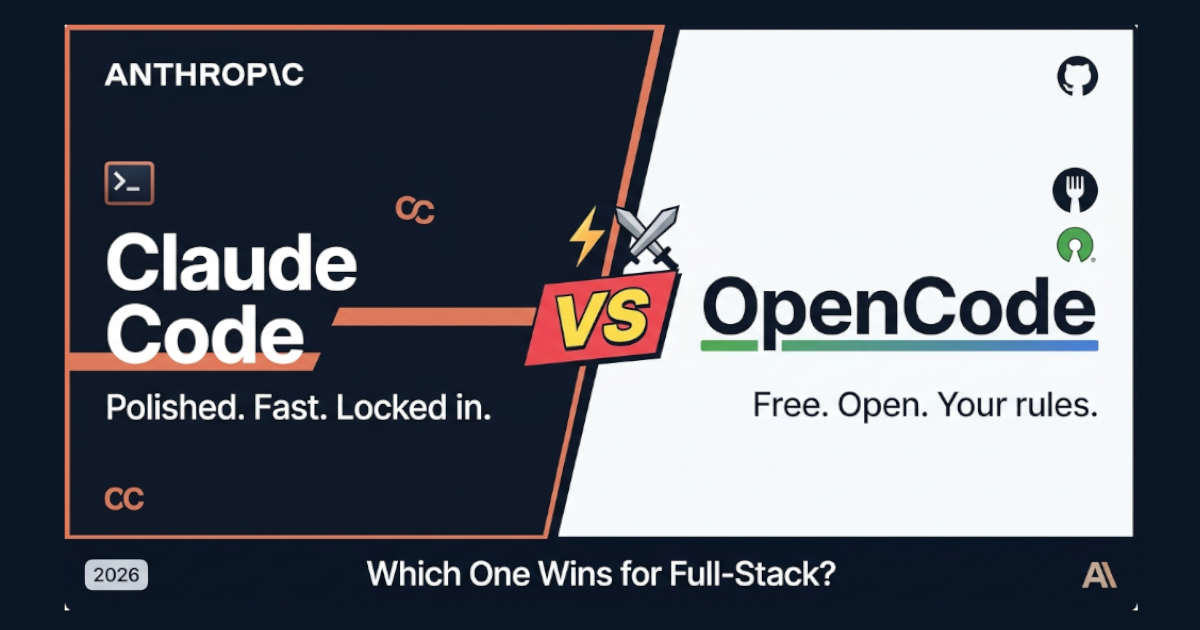
Claude Code = polished, works great out of the box, but you're stuck with Claude models.
OpenCode = free, works with basically any model, but you gotta set things up yourself.
For full-stack devs, it really comes down to this: do you want easy mode or do you want control?
Read article on Skills for AI
What's Claude Code Anyway?
It's Anthropic's official coding agent. You install it, log in, and start throwing tasks at it from your terminal.
It only works with Claude models. Opus, Sonnet, Haiku. That's it.
The good news? Because Anthropic built it for their own models, everything just... works. No config needed. It knows how to talk to Claude properly.
What's good:
Actually understands your codebase. Like, it reads stuff before it starts changing things.
Agent Teams feature. Multiple sub-agents that can work together on big tasks.
Plugins, skills, MCP support. The ecosystem is pretty mature.
Works in terminal, desktop app, VS Code, JetBrains.
What's not:
Claude models only. No GPT, no Gemini, no local models.
You need a paid plan or API key.
What's OpenCode?
Open source coding agent. MIT license. You can literally read the code and change it if you want.
The big selling point? It works with 75+ providers. Claude, GPT, Gemini, Kimi, whatever. You can even run it fully local with Ollama.
What's good:
Model freedom. Switch providers whenever.
Privacy option. Run everything locally if you need to.
Open source. Fork it, modify it, whatever.
Free software. You only pay for the models you use.
What's not:
You set up more stuff yourself. Providers, keys, config.
Not as polished out of the box.
Learn what is Terminal AI Coders
What Actually Matters for Full-Stack Work
Let me get specific here. Because full-stack is different from just frontend or just backend.
You're constantly jumping between layers. UI components, API routes, database stuff, infra. The agent needs to see how it all connects.
Understanding Your Code
Claude Code is really good at this. I asked it to trace a webhook once—from the route handler all the way to the database write. It walked through every step, explained what each part did, and showed me where the actual mutation happened. Didn't touch anything until I said go.
That matters when you're in code you don't know well.
OpenCode is also solid here, but different. Its killer feature is LSP integration. It sees real compiler errors while it works. TypeScript yelling at it? It catches that and fixes it before showing you anything.
For TypeScript full-stack work, that's huge.
My take: Claude Code for understanding. OpenCode for catching its own mistakes.
Cross-Layer Work
This is where things get interesting.
When I'm fixing a bug that spans frontend validation, backend logic, and a database constraint—I need an agent that can hold all three in its head.
Claude Code's Agent Teams help. You spawn sub-agents for different parts. One does frontend, one does backend, one writes tests. They talk to each other.
OpenCode uses Plan and Build modes. Plan mode is read-only. Build mode lets it edit. You switch between them as you go.
Both work. Claude Code feels more automated. OpenCode feels more controlled.
Speed vs Thoroughness
Benchmarks show Claude Code finishes tasks about 45% faster. A cross-file refactor took Claude Code 2m 15s vs OpenCode's 4m 20s.
But OpenCode writes more tests. In one test, it wrote 94 tests vs Claude Code's 73.
So Claude Code is faster. OpenCode is more thorough.
Pick your poison.
Learn Loop Engineering
Speed Comparison
Side by Side
Claude Code | OpenCode | |
|---|---|---|
Models | Claude only | 75+ providers + local |
Price | $20-200/month | Free software, pay for models |
Code understanding | Excellent | Strong, LSP helps a lot |
Cross-layer work | Agent Teams | Plan/Build modes |
Speed | ~45% faster | Slower but thorough |
Privacy | API calls to Anthropic | Can run fully local |
Customization | Closed source | Fully open |
Setup | Minimal | You configure stuff |
Lock-in | High | None |
The OAuth Mess
Quick note on something that bit a lot of people.
In January 2026, Anthropic blocked third-party agents from using Claude Pro and Max subscriptions. So if you wanted Claude models in OpenCode, you had to pay API rates.
They softened this later. But the lesson stuck: when you use OpenCode with Claude models, you're paying per token, not subscription rates.
What this means:
Claude-first? Claude Code is cheaper for heavy use.
Want Claude in OpenCode? Budget for API costs.
OpenCode's Go tier ($10/month) uses open models. Way cheaper.
Privacy Stuff
If you work with sensitive code, this often decides it.
Claude Code keeps your code local. Only the conversation goes to Anthropic's API. It also works with AWS Bedrock and Google Vertex if you want inference in your own cloud.
OpenCode can run fully local. Ollama, LM Studio, whatever. Nothing leaves your machine.
For NDA work or regulated industries, that's not a feature. That's a requirement.
One caveat: there's a reported issue where session titles can hit OpenCode's cloud even in local mode. If privacy is your whole reason for choosing it, check that first.
Money Talk
Let's be real about costs.
Claude Code
Pro: ~$20/month (Sonnet + Opus, limits apply)
Max: $100-200/month (higher limits)
API: pay per token
The subscription is subsidized. Independent tests showed API costs for the same usage would be way higher.
OpenCode
Software: free
Models: whatever your provider charges
Go tier: $10/month for hosted open models
Local: free if you have the hardware
For heavy users, Claude Code's subscription usually wins on pure economics. If you're cool staying in Anthropic's world.
OpenCode wins if you want to route cheap tasks to cheap models and save the expensive ones for hard stuff.
My Verdict
Here's what I'd tell a full-stack dev making this call today.
If I Had to Pick One: Claude Code
Full-stack work is mostly about moving carefully through code you don't fully know yet. Understanding before changing matters more than raw speed. Claude Code fits that better.
The 45% speed advantage adds up over a day. And it works immediately. No setup afternoon.
The downside: You're locked in. If Anthropic changes pricing or policies, you feel it. The OAuth thing showed that vendor risk is real.
When I'd Pick OpenCode
You want model freedom. If you want to test GPT vs Claude vs Gemini on your actual code, OpenCode is the only way.
Privacy is a must. Local execution is real. Claude Code can't do it.
You want to own the stack. MIT license. Fork it, modify it, self-host it. No lock-in.
Budget is tight. Free tool. $10/month Go tier. Cheap models for easy tasks.
The Real Talk
Most full-stack devs I know use Claude Code. It works. It's fast. The subscription math is hard to beat.
But OpenCode folks are passionate for a reason. They traded convenience for control. For their workflow, that trade pays off.
Agentic AI Systems
Which One Should You Pick?
Go Claude Code if:
You want it to just work
You're already paying for Claude Pro or Max
Speed and polish matter more than flexibility
You work in terminal AND your IDE
Go OpenCode if:
You need model freedom
Privacy requires local execution
You want to pin exact model versions
You want to read or modify the code
One Last Thing
The tool matters less than how you use it.
Both will write confident, plausible, wrong code sometimes. Both will invent APIs that don't exist. Both need you watching.
"The best tool is the one you actually use."
The real question isn't OpenCode vs Claude Code. It's whether you're treating the agent like a senior engineer (you'll get burned) or like a fast collaborator whose work you check (you'll be fine).
Pick what fits your flow. Then keep your hand on the wheel.