Artificial intelligence is no longer a niche technology reserved for data scientists and research labs. It has moved into marketing departments, customer service teams, sales pipelines, and software development workflows. Employers are not just looking for people who understand AI in theory. They want people who can use it, build with it, and make smarter decisions because of it.
The challenge is that AI is changing fast. Skills that seemed advanced two years ago are now baseline expectations. Skills that sound technical today will soon be part of everyday business operations. Staying relevant means building a practical mix of technical knowledge and hands-on ability.
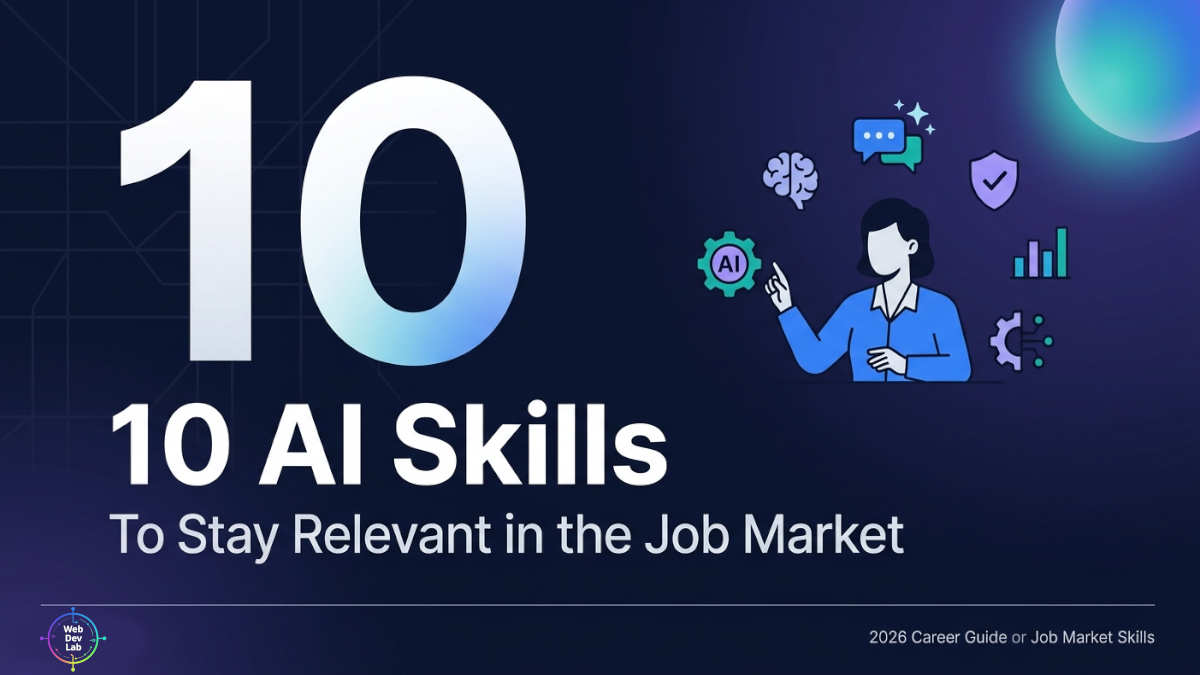
This article covers the 10 AI skills that matter most in today's job market. Whether you are a developer, a manager, or someone exploring a career shift, these skills will help you stay competitive and confident as AI continues to reshape how work gets done.
1. Machine Learning Fundamentals
Machine learning is the engine behind most modern AI tools. You do not need to become a machine learning researcher, but understanding how ML models learn, improve, and make predictions is a major advantage.
At its core, machine learning involves feeding data to algorithms so they can recognize patterns and make decisions without being explicitly programmed for every scenario. There are three main types of learning:
Supervised learning: The model learns from labeled examples, such as emails marked as spam or not spam.
Unsupervised learning: The model finds hidden patterns in data without labels, often used for customer segmentation.
Reinforcement learning: The model learns by trial and error, receiving rewards or penalties for its actions.
Practical knowledge of these concepts helps you communicate with technical teams, evaluate AI solutions, and understand why certain tools behave the way they do. For non-technical roles, this skill helps you ask better questions and spot unrealistic AI promises. For developers, it opens the door to building and fine-tuning models.
Employers value this skill because it bridges the gap between business goals and technical execution. Even a basic understanding of ML makes you more effective in almost any AI-related conversation.
2. Data Literacy and Analytics
AI runs on data. The quality of the data determines the quality of the output. That is why data literacy, the ability to read, interpret, and question data, has become one of the most important AI skills in the workplace.
Data literacy involves more than just looking at charts. It means understanding:
Where data comes from
Whether the data is reliable and complete
What biases might exist in the data
How data flows through an AI system
What the results actually mean for the business
Organizations are increasingly worried about AI transparency and trust. When you can examine the data behind an AI decision and explain it clearly, you become a valuable bridge between technical teams and business stakeholders.
For example, if a sales AI tool predicts a drop in quarterly revenue, a data-literate employee can ask: What data is this based on? Is the sample size large enough? Are there seasonal patterns the model might be missing? These questions prevent blind trust in AI outputs and lead to better decisions.
3. Programming Languages for AI
You do not need to code to use many AI tools today. But if you want to build, customize, or integrate AI systems, programming skills are essential.
Python remains the most popular language for AI and machine learning. It has a rich ecosystem of libraries for data analysis, natural language processing, and model development. Java is also widely used in enterprise environments where AI must integrate with large existing systems. Other languages like C++, Julia, and Scala appear in specialized AI projects where performance and scalability are critical.
Beyond writing code, AI programming skills include:
Working with APIs to connect AI services
Using open-source large language models
Fine-tuning pre-trained models for specific business needs
Building simple automation scripts that call AI tools
For web developers, this skill is especially relevant. Many modern applications now require integration with AI features like chatbots, recommendation engines, or content generation tools. Knowing how to connect these services and troubleshoot them makes you significantly more valuable.
4. Statistics and Mathematical Thinking
AI models are built on statistics and mathematics. While you do not need a PhD in math, a solid grasp of core concepts helps you understand what AI is actually doing under the hood.
Key areas include:
Probability and distributions
Linear algebra basics
Statistical significance
Regression and classification concepts
Model evaluation metrics like accuracy, precision, and recall
These concepts help you judge whether an AI model is performing well or just looking good on paper. For example, knowing the difference between precision and recall matters when evaluating a fraud detection system. A model that catches most fraud but also blocks many legitimate transactions might have high recall but poor precision. That distinction has real business consequences.
Mathematical thinking also helps you spot when AI outputs are misleading. If a model claims 95% accuracy but was trained on imbalanced data, a statistically minded employee will know to dig deeper before trusting the result.
5. AI Model Development and Evaluation
AI model development is the process of building, testing, and refining AI systems to solve specific problems. This is a technical skill, but the underlying mindset is useful for anyone involved in AI projects.
Every AI model is different. A model built to recommend products is not the same as one built to analyze legal documents or generate marketing copy. Each has different goals, constraints, and failure modes.
Model development involves:
Defining the problem clearly
Selecting the right type of model
Preparing and cleaning training data
Training and testing the model
Evaluating performance against real-world criteria
Iterating and improving over time
Even if you never build a model yourself, understanding this process helps you appreciate why AI projects take time and why some tools work better than others. It also helps you communicate with AI engineers and set realistic expectations for what AI can and cannot do.
6. AI Tool Proficiency
AI tools are everywhere now. Research tools, writing assistants, analytics platforms, customer service bots, design software, almost every category of business software has some AI component.
AI tool proficiency means more than knowing how to open an app and type a question. It means understanding how to get the best results from different tools and knowing which tool is right for which task.
For example, a content writer might use one AI tool for brainstorming ideas, another for editing grammar, and another for generating social media variations. A project manager might use AI to summarize meeting notes, track action items, or generate status reports.
Practical tips for building AI tool proficiency:
Experiment with multiple tools in the same category
Learn each tool's strengths and limitations
Understand how settings and inputs affect outputs
Keep up with new features and updates
Document prompts and workflows that work well
This skill is valuable because it is immediately applicable. You can start using AI tools in your current role today, regardless of your job title or technical background.
7. Prompt Engineering
Prompt engineering is the practice of crafting clear, specific instructions to get better responses from AI systems. It sounds simple, but doing it well requires practice and a good understanding of how AI language models work.
AI excels at generating content but often struggles with context. A vague prompt produces a vague answer. A well-structured prompt produces a focused, useful response.
Good prompt engineering involves:
Being specific about what you want
Providing relevant background or examples
Setting constraints like tone, length, or format
Breaking complex requests into smaller steps
Iterating and refining based on the output
For example, instead of asking an AI tool to "write a sales email," a prompt engineer might say: "Write a polite follow-up email to a potential client who requested a product demo but hasn't responded in five days. Keep it under 150 words, use a friendly but professional tone, and include a clear call to action."
This skill matters because it makes every AI interaction more productive. It is also increasingly listed in job descriptions across marketing, sales, customer service, and operations roles.
8. AI Ethics and Responsible Use
As AI becomes more powerful, the risks of misuse grow. Bias, privacy violations, misinformation, and lack of transparency are real concerns that companies are now taking seriously.
AI ethics and responsible use means understanding these risks and knowing how to reduce them. This includes:
Recognizing potential bias in AI training data
Ensuring AI systems do not discriminate against certain groups
Protecting user privacy and sensitive information
Being transparent about when and how AI is used
Complying with emerging AI regulations and standards
This skill is valuable because it protects both the company and its customers. An employee who can identify an ethical risk before it becomes a public relations disaster is worth their weight in gold.
For example, if a hiring AI tool consistently filters out candidates from certain backgrounds, an ethics-aware employee would flag the issue, investigate the training data, and recommend corrective action before the company faces legal or reputational damage.
9. Critical Thinking with AI
AI is a tool, not an oracle. It makes mistakes, produces biased outputs, and sometimes generates confident-sounding nonsense. That is why critical thinking remains one of the most important AI skills.
Critical thinking with AI means:
Questioning AI outputs instead of accepting them at face value
Comparing AI results against your own knowledge and experience
Identifying when an AI model is operating outside its comfort zone
Understanding the limitations of AI in specific contexts
Knowing when to trust AI and when to rely on human judgment
For example, an AI tool might generate a professional-looking market analysis with compelling charts and confident conclusions. A critical thinker would ask: What data was used? What assumptions did the model make? Are the conclusions supported by other sources? These questions prevent costly mistakes.
This skill is especially important as AI systems become more sophisticated and their outputs become harder to distinguish from human work. The ability to evaluate AI outputs critically will become a core professional skill across industries.
10. Cross-Functional Collaboration
AI projects rarely live in a single department. They involve data scientists, developers, product managers, marketers, sales teams, and customer service representatives. The people who can bring these groups together are increasingly valuable.
Cross-functional collaboration with AI means:
Understanding enough about AI to communicate with technical teams
Translating business needs into AI requirements
Helping non-technical colleagues understand AI capabilities
Connecting data and insights across departments
Breaking down silos between teams working on related AI initiatives
For example, a marketing team might want to use AI for personalized email campaigns. That project might require input from data engineering to ensure data quality, legal to ensure compliance, and IT to manage integration. A person who can coordinate these groups and keep the project moving is invaluable.
This skill is about more than being a good communicator. It is about understanding how AI fits into the broader business and helping different teams work together toward shared goals.
How to Start Building These AI Skills
You do not need to master all ten skills at once. The best approach is to start with the skills most relevant to your current role and build from there.
Take free or low-cost courses. Many platforms now offer beginner-friendly AI courses. Look for courses that include hands-on exercises rather than just theory.
Practice with real tools. Start using AI tools in your daily work. Experiment with different prompts, compare outputs, and learn from what works and what doesn't.
Learn from your team. If your company is already using AI, ask to shadow the people working on those projects. The fastest way to learn is often by observing others.
Join AI communities. Online forums and local meetups are great places to ask questions, share experiences, and stay current with new developments.
Stay informed. AI changes quickly. Follow reputable sources, read industry reports, and pay attention to how AI is being used in your field.
Conclusion
AI skills are no longer optional extras. They are becoming part of the baseline expectation for professionals in almost every industry. The good news is that you do not need to become a machine learning expert to stay relevant. You need a practical mix of technical understanding and real-world application.
Focus on the skills that matter most for your role. Learn how AI works, practice using AI tools, and always apply critical thinking. The people who thrive in the AI era will not be those who know everything about AI. They will be the ones who know how to use AI effectively, ethically, and intelligently to create real value.
The job market is changing. With the right skills, you can change with it.