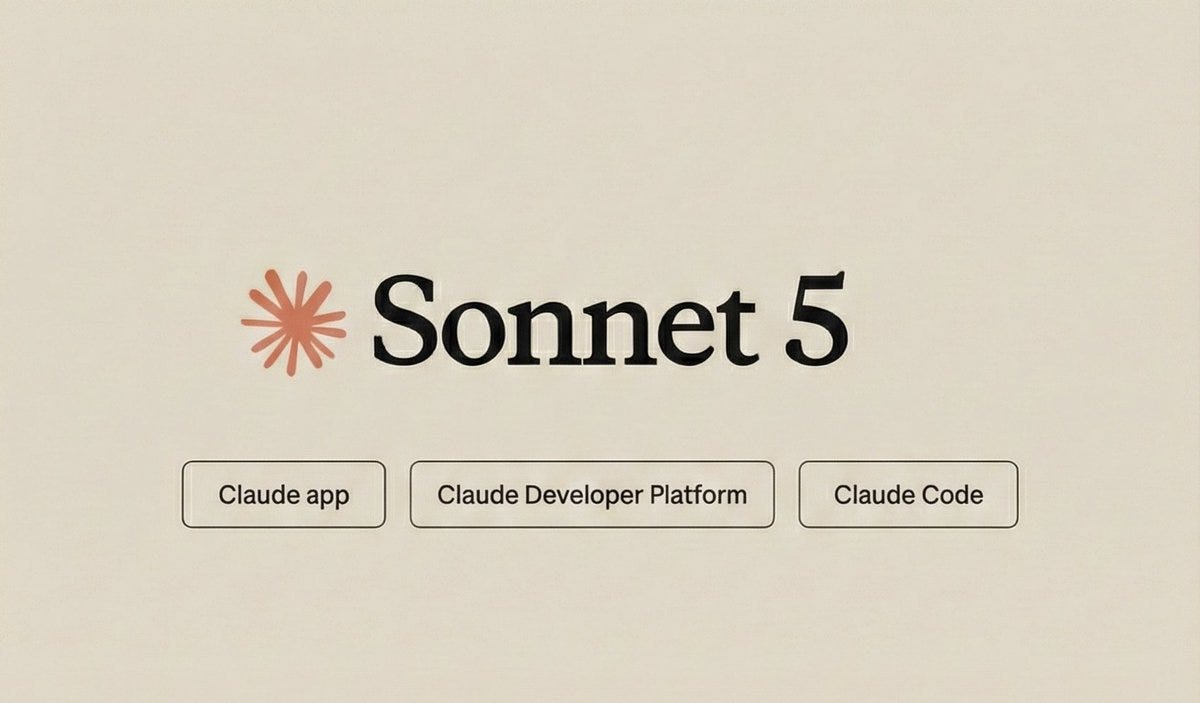
Artificial intelligence is evolving at an incredible pace, and Anthropic has just taken another major step forward with the launch of Claude Sonnet 5. Rather than releasing another incremental update, the company skipped the expected 4.x versioning and introduced Sonnet 5, signaling a much larger leap in performance.
The headline is simple: Claude Sonnet 5 delivers significantly better reasoning, coding, and autonomous task execution while costing far less than Claude Opus 4.8. For developers, startups, and enterprises, that combination could make it one of the most attractive AI models currently available.
In this article, we'll break down everything you need to know, from benchmarks and pricing to safety improvements and what the launch means for AI developers.
Claude Sonnet 5 at a Glance
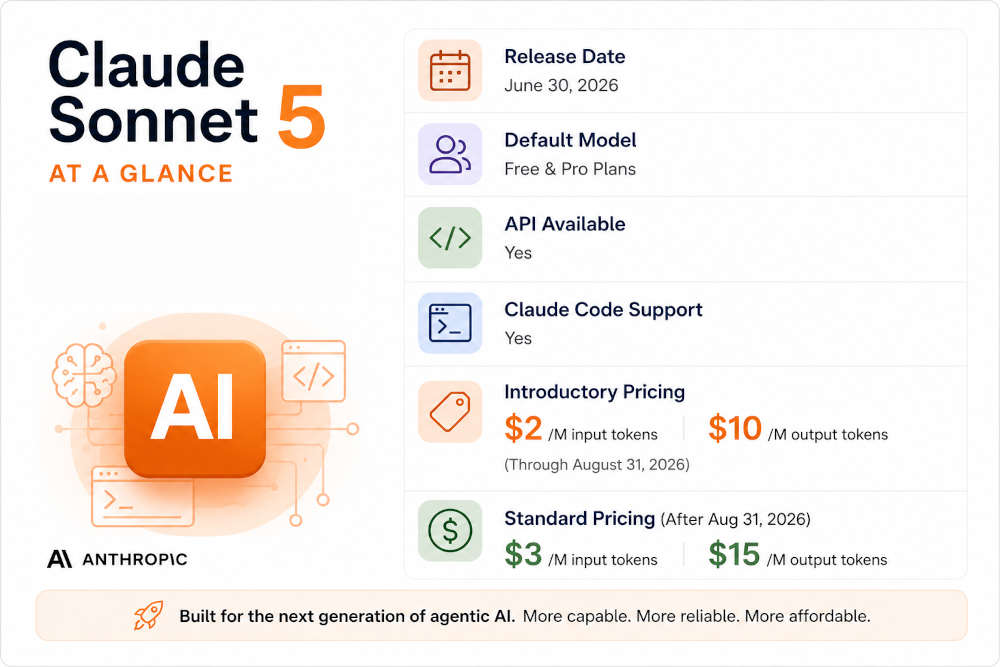
According to Anthropic, Claude Sonnet 5 is its most capable Sonnet model to date. The model can plan multi-step tasks, interact with tools like browsers and terminals, write high-quality code, and complete complex workflows with minimal user intervention. Compared to previous Sonnet models, it offers significantly better reasoning, stronger coding performance, improved safety, and a much better price-to-performance ratio, making it one of the most competitive AI models available today.
Why Claude Sonnet 5 Matters
The biggest story isn't simply that Sonnet 5 is faster.
It's that the performance gap between the Sonnet and Opus families has become much smaller.
For years, developers typically faced a familiar decision:
Use Sonnet for speed and affordability.
Use Opus for maximum intelligence.
Claude Sonnet 5 changes that equation.
According to Anthropic, Sonnet 5 approaches Claude Opus 4.8 on many reasoning, coding, and knowledge tasks while maintaining significantly lower pricing.
That means developers no longer have to sacrifice as much capability in exchange for lower costs.
Claude Sonnet 5 Performance Improvements
Anthropic reports improvements across nearly every important category.
Better Coding
One of the clearest improvements appears in agentic coding.
ModelAgentic Coding ScoreClaude Sonnet 4.658.1%Claude Sonnet 563.2%Claude Opus 4.869.2%
Although Opus still leads, Sonnet 5 dramatically closes the gap.
For many software engineering tasks, including debugging, refactoring, automation, and API development, the difference may be small enough that the lower cost becomes the deciding factor.
Improved Agentic Workflows
Anthropic emphasizes that Sonnet 5 is much more capable of:
Planning multi-step tasks
Using external tools
Searching information autonomously
Checking its own work
Completing workflows without repeated user intervention
Early testing partners reported that Sonnet 5 often finishes tasks that previous Sonnet models abandoned midway.
This makes it especially valuable for AI agents, coding assistants, research workflows, and automation systems.
Better Cost Efficiency
In my opinion, pricing is where Claude Sonnet 5 really stands out. Anthropic has managed to deliver a model that's remarkably close to Opus-level performance while keeping the cost significantly lower. For many developers and businesses, that balance could be a game changer.
Pricing is one of Sonnet 5's biggest strengths.
Introductory Pricing (Until August 31, 2026)
$2 per million input tokens
$10 per million output tokens
Standard Pricing
$3 per million input tokens
$15 per million output tokens
For comparison, Claude Opus 4.8 costs:
$5/M input
$25/M output
That represents roughly a 40–60% cost reduction, depending on usage.
For companies processing billions of tokens every month, those savings can translate into substantial reductions in infrastructure costs.
Safety Improvements
Performance isn't the only area that improved.
Anthropic also reports better safety.
Compared with Sonnet 4.6, Claude Sonnet 5 demonstrates:
Lower hallucination rates
Better resistance to prompt injection
Improved refusal of malicious requests
Reduced sycophancy
Fewer undesirable behaviors during autonomous execution
Interestingly, Anthropic intentionally did not optimize Sonnet 5 for offensive cybersecurity tasks.
In internal testing, it remained considerably less capable than Opus models at generating software exploits, while still performing routine defensive and non-harmful security tasks.
Cyber safeguards are enabled by default.
Claude Sonnet 5 Availability
One thing I really like about this launch is that Anthropic isn't limiting Claude Sonnet 5 to premium customers. Instead, the company has rolled it out across almost its entire ecosystem, making it easy for both individual users and organizations to start using the model right away.
The rollout is broad.
Claude Sonnet 5 is now available for:
Free users
Pro users
Max subscribers
Team plans
Enterprise customers
Developers can also access the model through:
Claude API
Claude Code
Anthropic Platform
Frontier Models Are Returning Too
Alongside Sonnet 5, Anthropic is also restoring access to its frontier models.
Following changes to U.S. export restrictions, Claude Fable 5 is returning worldwide across Claude services.
Anthropic has also indicated that access through major cloud providers, including AWS, Google Cloud, and Microsoft Foundr, will be restored as infrastructure becomes available.
Meanwhile, Claude Mythos 5 remains restricted to selected partner organizations.
For AI researchers and enterprises, this means more flexibility when selecting models based on capability, compliance, and cost.
What This Means for Developers
Claude Sonnet 5 shifts the conversation from "Which model is the smartest?" to "Which model delivers the best value?"
Many production applications don't require absolute frontier-level intelligence.
Instead, they benefit more from:
Lower inference costs
Faster response times
Reliable reasoning
Strong coding performance
Better autonomous task completion
Sonnet 5 appears to strike an impressive balance between those priorities.
Organizations can reserve premium models like Opus or Fable for evaluation, research, or the most demanding workloads while deploying Sonnet 5 at scale for day-to-day production systems.
Final Thoughts
Claude Sonnet 5 isn't just another model update, it represents a meaningful shift in the economics of AI.
By narrowing the performance gap with Claude Opus 4.8 while offering significantly lower pricing, Anthropic has created a model that could become the default choice for many developers, startups, and enterprises.
Whether you're building AI agents, coding assistants, research tools, customer support systems, or enterprise automation, Claude Sonnet 5 deserves serious consideration.
The real competition is no longer simply about achieving the highest benchmark scores. It's about delivering the best combination of intelligence, reliability, safety, and affordability, and Claude Sonnet 5 makes a compelling case that this balance is where the future of practical AI is heading.