
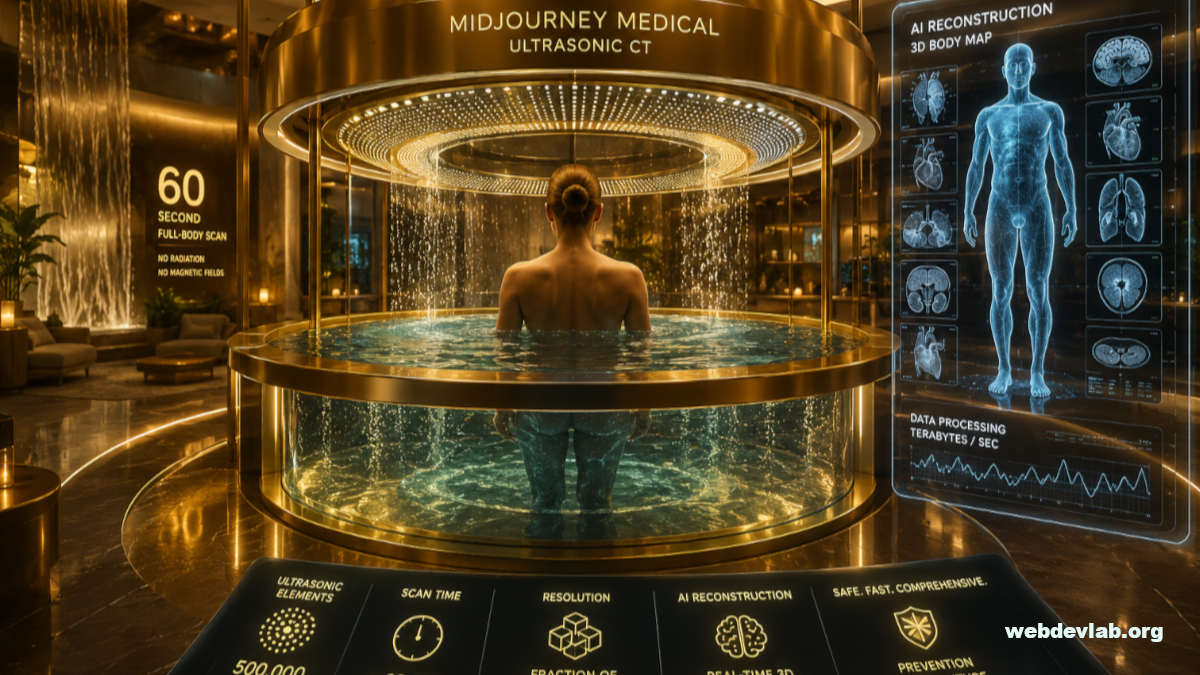
So Midjourney just announced they're building a medical scanner. Yeah, the AI art company. Weird right?
They're calling it Midjourney Medical. The pitch is wild — full-body scans in under 60 seconds. No radiation. No giant magnetic tube. Just sound waves and AI.
Sounds too good? Maybe. Let's break it down.
Quick Summary
Midjourney started a health division called Midjourney Medical
Their scanner does full-body imaging in under 60 seconds (they claim)
It uses ultrasound, not radiation or magnets
First public scanning spa is planned for San Francisco
They want 50,000 scanners worldwide by 2031
They say it could cut global deaths by 30% and healthcare costs by 50%
Imaging experts are skeptical — no peer-reviewed evidence yet
What Are They Actually Building?
Here's the idea. Take ultrasound. Make it as good as MRI. Make it fast and cheap.
That's the goal anyway.
The thing is called Ultrasonic CT. And it doesn't look like a normal scanner.
You don't lie inside a big magnet. Instead, you stand on a platform. Then you get lowered into a shallow pool of water. There's a circular ring around you.
As you go down, tons of ultrasonic sensors fire sound waves. They listen for echoes coming back from your body. Midjourney says AI then builds a 3D model of your insides.
What you get, according to them:
Full-body scan in under 60 seconds
No radiation
No strong magnets
Super fine detail
MRI-like images
They describe it like being surrounded by "half a million tiny dolphins" using echolocation. Cool visual, honestly.
How It Works
Part | What It Does |
|---|---|
Method | Ultrasound |
Sensors | About 500,000 elements |
Scan Time | Under 60 seconds (target) |
Medium | Water |
Data | Terabytes per second |
Output | AI-built 3D model |
Radiation | None |
Magnets | None |
Why Water?
Water isn't random. It helps sound waves travel through your body.
Since you're surrounded by water, the scanner can grab data from all angles at once. Normal ultrasound can't do that.
The ring has like half a million tiny ultrasound elements. Each one is both a speaker and a microphone. They send sound, then listen for what bounces back.
Midjourney says this makes terabytes of data every second. That's where AI comes in — to make sense of all that noise.
Regular ultrasound? A tech holds a probe. Way different.
Wait, Midjourney Does Medical Now?
Yeah, it's a surprise. Midjourney is known for AI images. Not healthcare.
They admit it's a big shift. They say it's part of figuring out what they want to be.
One thing though — they don't have outside investors. No VC pressure. That means they can chase long-term stuff that normal startups wouldn't touch.
The Butterfly Network Deal
They're not doing this alone. They partnered with Butterfly Network. That company makes ultrasound-on-chip tech.
Reports say Midjourney signed an exclusive licensing deal with Butterfly in late 2025.
Deal Part | Reported Value |
|---|---|
Upfront | $15 million |
Yearly License | $10 million |
Milestones | Up to $9 million |
Total | Up to $74 million |
The prototype uses dozens of Butterfly ultrasound modules in one system.
The Spa Thing Is Weird
Here's where it gets interesting. They're not putting these in hospitals.
They're putting them in spas.
First one is planned for Union Square in San Francisco. 23,000 square feet. Four floors.
Think hot tubs, saunas, cold plunges, waterfalls, mood lighting. And scanning pools.
CEO David Holz said: "I don't want to feel like I'm going to a doctor's office."
It'll run 24/7 with multiple scanners.
Their Global Plan Is Huge
Like, really huge.
Goal | Target |
|---|---|
Scanners | 50,000 |
By | 2031 |
Scans Per Month | 1 billion |
Spa Locations | ~5,000 |
Cost | ~$20 billion |
They claim their network could eventually do more scans per year than every MRI machine on Earth combined.
That's a massive claim. If it happens, it's one of the biggest healthcare builds ever.
Why Prevention Matters
The logic is simple. Catch diseases early. Treat them cheaper and easier.
Might work for:
Cancer
Spot weird tissue changes sooner
Screen more often
Women's Health
Breast imaging
Reproductive monitoring
Body changes during menopause
Heart Health
Check heart structure
Watch circulation
Body Composition
Muscle mass
Fat distribution
Bone health
They say this could prevent 30% of global deaths and 50% of healthcare costs.
But those are their numbers. Not proven yet.
Why Doctors Are Skeptical
Not everyone's buying it. Radiologists have questions.
Four main concerns:
1. No Real Evidence Yet
Midjourney hasn't shown:
Peer-reviewed studies
Independent testing
Clinical trials
Real benchmarks
Doctors need this stuff before trusting any diagnostic tool.
2. Ultrasound Has Limits
Ultrasound is useful. But it has problems.
Bones block sound
Air-filled organs mess things up
Image quality varies
Soft tissue looks different than on MRI
These aren't software bugs. They're physics. Been that way forever.
3. MRI Comparisons Need Proof
Midjourney keeps comparing itself to MRI.
Experts say: fine, but show us. Same resolution? Same accuracy? Same sensitivity? Nobody's seen that yet.
4. FDA Approval Is Still Needed
Even if the tech works, it needs regulatory approval.
Midjourney says they'll go for FDA clearances over time. Start with low-risk stuff like body composition. Then move to actual diagnosis.
What Needs to Happen Next
For doctors to take this seriously:
Peer-reviewed research
Clinical trials
Independent testing
FDA clearance
Real-world studies
Head-to-head comparisons with MRI and CT
Until then? It's just promises.
So Is This the Future?
Maybe. Hard to say.
One thing's clear — the lines between AI, healthcare, tech, and wellness are blurring fast.
Midjourney isn't just selling a scanner. They're selling a different idea. One where getting scanned is as normal as going to the gym.
Bold vision. But bold visions need proof.
Final Thoughts
Midjourney Medical might be the most ambitious health project this decade.
60-second scans. No radiation. AI images. Spa vibes. Plus 50,000 scanners and a billion scans a month.
But excitement doesn't equal evidence. No peer-reviewed studies. No clinical validation. No FDA approval. Right now, it's a promise, not a breakthrough.
Next few years will tell us everything.
If it works? Huge deal for preventive healthcare.
If not? Well, it's a good reminder — changing medicine takes more than cool ideas. It takes proof.