
Introduction
Walk through any robotics trade show in 2026, and you'll see a strange disconnect.
The main stage features humanoid robots waving, dancing, and shaking hands. Crowds gather to watch them climb stairs or fold shirts. Cameras flash. Investors nod approvingly.
But walk to the back aisles, the unglamorous booths with beige carpet and folding tables, and you'll find something different. Wheeled platforms moving pallets. Articulated arms picking boxes. Suction grippers transferring items from bin to bin. No faces. No legs. No personality.
These machines don't attract crowds. They don't make headlines. But they're the ones actually transforming how warehouses, factories, and fulfillment centers operate.
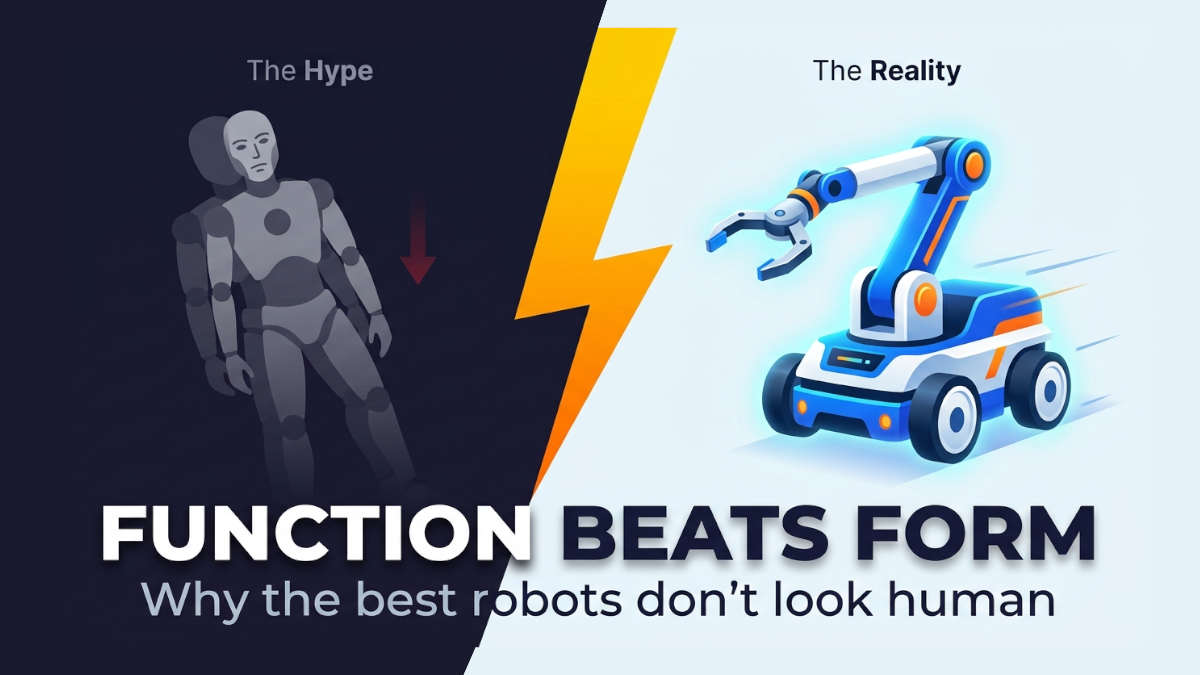
This article explains why the real future of robotics isn't humanoid, and why that's not a disappointment, but a revelation.
The most important question in robotics isn't "Can we make machines look like us?" It's "What is the fastest, cheapest, and most reliable way to get the job done?"
When you ask that question honestly, the answer rarely looks human.
Understanding the Core Question
Before we dive into specific technologies, let's establish a framework for thinking about robotics.
What Problem Are We Solving?
Every robot exists to solve a problem. A robotic vacuum solves floor cleaning. A warehouse robot solves product movement. A surgical robot solves precision cutting.
The problem should determine the design, not the other way around.
Think about it this way: if you need to move a refrigerator across town, you don't build a mechanical horse. You use a truck. The truck doesn't look like a horse, doesn't eat hay, and doesn't need rest. It's simply better at the specific task of transporting heavy objects over paved roads.
The same logic applies to warehouse automation. If you need to move boxes from shelves to conveyor belts, why build a machine with legs and hands? Why not build something optimized specifically for that task?
Form Follows Function
In architecture and industrial design, there's a principle: form follows function. It means the shape of an object should relate primarily to its intended purpose.
A chair looks like a chair because it's designed for sitting. A knife looks like a knife because it's designed for cutting. Would you trust a chair that looked like a bicycle? Or a knife shaped like a spoon?
Yet in robotics, we somehow convinced ourselves that the ideal form is a human body. This assumption deserves scrutiny.
The human body is remarkable, but it evolved for survival on the African savanna, not for picking items in a warehouse. Our legs are optimized for walking long distances over uneven terrain. Our hands are optimized for manipulating diverse objects in unpredictable environments. Our eyes are optimized for spotting predators and ripe fruit.
None of these evolutionary constraints apply to a distribution center.
Why Humanoid Robots Capture Attention
Before we dismiss humanoids entirely, let's understand why they dominate the conversation.
The Psychological Appeal
Humans are wired to recognize and respond to faces. We anthropomorphize everything, pets, cars, even weather patterns. A robot with a face triggers emotional responses that a wheeled platform never will.
This psychological bias affects investors, journalists, and the public. We want robots to look like us because it makes them feel familiar and approachable. It's the same reason science fiction movies feature humanoid robots even when the plot doesn't require them.
The Versatility Argument
The strongest technical argument for humanoids is versatility. The world is designed for human bodies. Doorways are human-sized. Stairs are human-proportioned. Tools are human-gripped. A humanoid robot could theoretically operate in any environment built for people without modification.
This argument has merit, in environments designed for humans. Homes. Hospitals. Offices. Disaster zones.
But warehouses aren't designed for humans. They're designed for storage and movement of goods. Forklifts, pallet jacks, and conveyor belts already work in these spaces. The environment has already adapted to machines.
The Investment Cycle
Humanoid robotics startups have raised billions in venture capital. This creates a self-reinforcing cycle: funding drives media attention, media attention drives more funding, and more funding drives more demos.
But funding and demos don't equal deployment. The gap between a viral video and a profitable production system is enormous.
The Warehouse: A Case Study in Task Optimization
Let's examine a typical warehouse environment to understand why non-humanoid designs win.
What Actually Happens in a Warehouse
A fulfillment center has a straightforward workflow:
Receive products from manufacturers
Store items on shelves or in bins
Pick items when orders arrive
Pack orders for shipping
Ship packages to customers
Each step involves moving objects from one location to another. The objects are typically boxes, totes, or poly-bagged items, uniform in general shape, varying in size and weight.
Why Wheels Beat Legs
In a warehouse, floors are flat and smooth. Aisles are straight and wide. Obstacles are predictable and avoidable.
Wheels are simply better than legs in this environment.
A wheeled robot moves faster, uses less energy, and requires fewer control systems than a legged robot. Consider the engineering difference:
A wheeled base needs:
Electric motors
Wheels
Basic suspension (optional)
Steering mechanism
A legged robot needs:
Multiple actuators per leg (at least 2-3 each)
Balance control systems
Gait planning algorithms
Complex sensor fusion for stability
Fall detection and recovery mechanisms
The wheeled robot has fewer parts that can fail, consumes less power, and moves at 2 meters per second without breaking a sweat. The legged robot needs constant adjustment just to stay upright.
Tip: When evaluating robotics for a facility, ask: "Does this environment require legs?" If the answer is no, don't pay for them.
Why Suction Beats Hands
Picking up a box seems simple. But robotic grasping is one of the hardest problems in robotics.
A human hand has 27 degrees of freedom, 27 different ways it can move. Controlling all those joints to grip an object of unknown weight, texture, and rigidity requires massive computational power and sophisticated sensors.
A suction gripper has one moving part: a valve that controls vacuum pressure.
For boxes, totes, and packages with flat or semi-flat surfaces, suction works remarkably well:
Faster: Suction engages instantly. No need to plan finger positions or grip angles.
Cheaper: A suction end effector costs $100-$1,000. A robotic hand costs $10,000-$100,000.
More reliable: Fewer moving parts means fewer failures.
Simpler control: On/off vacuum pressure vs. complex finger coordination.
Common mistake: Assuming robotic hands are necessary because humans use hands. Humans use hands because evolution gave us hands, not because hands are the optimal tool for every task.
Why Lift Systems Beat Bending
When a human picks up a box from the floor, they bend at the knees and waist. This complex motion involves multiple muscle groups and requires significant energy.
A scissor lift does the same job with one hydraulic cylinder. It goes up. It goes down. That's it.
The lift system doesn't need to balance, doesn't need to coordinate multiple joints, and doesn't get tired. It just works, consistently, reliably, and cheaply.
Real-World Applications: Where Non-Humanoid Robots Excel
Let's look at specific use cases where task-optimized robots outperform humanoids.
Autonomous Mobile Robots (AMRs)
AMRs are wheeled platforms that navigate autonomously using LiDAR, cameras, and internal maps. They look like flat carts or small platforms, nothing humanoid about them.
What they do: Transport goods from one location to another.
Why they win:
Move up to 2.5 meters per second
Operate 24/7 with battery swapping
Navigate crowded spaces safely
Cost $20,000-$50,000 per unit
AMRs have become standard equipment in modern warehouses. Companies like Amazon deploy thousands of them. They don't look impressive, but they move millions of packages daily.
Collaborative Robot Arms (Cobots)
Cobots are articulated arms designed to work alongside humans. They mount on tables, pedestals, or mobile bases.
What they do: Pick, place, sort, assemble, and inspect items.
Why they win:
Repeatability down to ±0.025 mm
Payload capacity up to 18 kg
Programmable through no-code interfaces
Cost $30,000-$60,000 per unit
The key advantage of cobots is their specificity. A cobot designed for pick-and-place doesn't need legs or a face. It needs a reliable arm, a good gripper, and smart software.
Automated Storage and Retrieval Systems (AS/RS)
AS/RS are large-scale systems that store and retrieve items automatically. They consist of vertical racks, shuttle robots, and lift mechanisms.
What they do: Store items in dense configurations and retrieve them on demand.
Why they win:
Maximize vertical space utilization
Reduce floor space requirements by up to 60%
Achieve retrieval times under 60 seconds
Eliminate human walking time entirely
AS/RS systems look nothing like humans. They look like giant vending machines. But they're incredibly efficient at their specific task.
The Role of AI in Task-Optimized Robotics
Some people assume that AI advancements will make humanoid robots more viable. This is partially true, but it also makes specialized robots better.
AI Improves What Already Works
Machine learning algorithms can optimize AMR routing, improve suction gripper positioning, and predict maintenance needs. These improvements compound the advantages of specialized designs.
For example, an AI-powered AMR can learn traffic patterns in a warehouse and adjust its routes to avoid congestion. It doesn't need legs to benefit from AI, it just needs better software.
The Fallacy of "General Intelligence"
There's a common assumption that artificial general intelligence (AGI) will make humanoid robots practical. The logic goes: once robots can think like humans, they'll need human-like bodies to interact with the world.
This assumption ignores a fundamental truth: intelligence is not tied to physical form.
A warehouse robot doesn't need to think like a human to navigate a warehouse. It needs to solve the specific problem of moving from Point A to Point B efficiently. A specialized algorithm can do this better than any general-purpose intelligence.
Key insight: Don't confuse "smart" with "human-like." A calculator is extremely smart at arithmetic but looks nothing like a human. The same principle applies to robotics.
Challenges and Limitations
We should be honest about what non-humanoid robots can't do.
Unstructured Environments
Specialized robots excel in structured environments, warehouses, factories, distribution centers. But they struggle in unstructured environments like homes, hospitals, or disaster zones.
If your environment has stairs, uneven floors, unpredictable obstacles, or constantly changing layouts, a wheeled robot might not work. In these cases, legged robots or humanoids might eventually have a role.
Task Variety
A suction gripper is excellent for boxes but useless for picking up a coffee mug or a loose cable. Specialized robots are, by definition, limited in their versatility.
If you need a robot that can perform many different tasks, you'll either need multiple specialized robots or a more general-purpose design.
The Innovation Timeline
We're still early in the robotics revolution. Specialized robots have a head start because they're simpler and cheaper, but humanoid technology is improving rapidly.
In 10-20 years, humanoid robots might become practical for certain applications. But they'll likely never replace specialized robots in structured environments, just as trucks haven't replaced conveyor belts.
How to Evaluate Robotics for Your Business
If you're considering warehouse automation or robotics investment, here's a practical framework.
Step 1: Define the Task
Write down exactly what you want the robot to do. Be specific:
"Move boxes from Receiving Dock A to Storage Zone B"
"Pick items from shelves 1-50 and place on conveyor"
"Palletize boxes for outbound shipping"
Step 2: Analyze the Environment
Document the physical constraints:
Floor surface and condition
Aisle widths and heights
Obstacles and traffic patterns
Temperature and humidity
Step 3: Calculate Cost Per Task
For each robot option, calculate:
Purchase or lease cost
Installation and integration cost
Maintenance and energy cost
Expected lifespan
Estimated throughput
Divide total cost by total tasks performed to get cost per task.
Step 4: Pilot Before Committing
Run a small pilot with 1-2 robots before scaling. Measure actual performance against projections. Be willing to walk away if the data doesn't support the investment.
Step 5: Involve Your Team
Your associates will work alongside these robots. Involve them early, address their concerns, and provide training for new roles. Automation works best when people understand and support it.
The Future: What Comes Next
So where is robotics heading?
Short-Term (2026-2028)
AMRs become standard in warehousing and logistics
Cobots proliferate in small and mid-sized manufacturing
Suction and soft grippers improve for handling diverse items
AI-driven fleet management optimizes robot coordination
Medium-Term (2028-2032)
Multi-robot orchestration becomes turnkey
Robotics-as-a-Service makes automation accessible to small businesses
Computer vision enables robots to handle unstructured items
Humanoid pilots expand in controlled environments
Long-Term (2032-2040)
Hybrid systems combine specialized robots with limited human oversight
Adaptive grippers handle nearly any object
Humanoids may find niche roles in unstructured environments
The line between "robot" and "machine" blurs
But here's the key prediction: task-optimized robots will remain dominant wherever tasks are well-defined. The future of robotics isn't about replacing humans with human-shaped machines. It's about building tools that do specific jobs better than any general-purpose system could.
Frequently Asked Questions
Why don't warehouse robots look like humans?
Warehouse robots don't look like humans because warehouses weren't designed for human bodies. Flat floors favor wheels over legs. Box-like objects favor suction grippers over hands. The environment determines optimal design, and that design looks nothing like a person.
Are humanoid robots a waste of money?
Not necessarily. Humanoid robots may become valuable in unstructured environments like homes, hospitals, and disaster zones, places designed for human bodies. But in structured environments like warehouses and factories, specialized robots deliver better ROI today.
What is the most important factor in robot design?
The most important factor is task fit. A robot should be designed for the specific job it needs to perform, not for aesthetic appeal or public perception. Cost per successful task matters more than technological sophistication.
Can AI make humanoid robots practical?
AI improves both humanoid and non-humanoid robots. But AI doesn't change the fundamental physics: wheels are more efficient than legs on flat surfaces, and suction is simpler than fingers for flat objects. AI makes good designs better; it doesn't make poor designs good.
What's the biggest mistake companies make with robotics?
The biggest mistake is choosing technology based on hype rather than ROI. Companies see viral videos of humanoid robots and assume they need that technology. But the unglamorous wheeled robot in the back of the warehouse often delivers far better returns.
Will robots replace warehouse workers?
Robots will change warehouse jobs, not eliminate them entirely. Automation handles repetitive physical tasks, while humans handle exceptions, supervision, and continuous improvement. The key is retraining workers for higher-value technical roles.
How do I calculate the ROI of a warehouse robot?
Calculate cost per pick: divide total cost (purchase, installation, maintenance, energy) by total picks over the robot's lifespan. Compare this to human cost per pick (fully loaded labor cost divided by picks per hour). If the robot's cost per pick is significantly lower, the investment makes sense.
What should I look for in a warehouse automation vendor?
Look for vendors who focus on task fit rather than flashy demos. Ask for reference customers in your industry. Request performance data from production deployments, not pilot programs. And ensure they provide training and support for your team.
Summary
The future of robotics isn't about building machines that look like humans. It's about building machines that solve problems efficiently.
In warehouses, factories, and distribution centers, the winning designs are wheeled platforms, articulated arms, and suction grippers, machines that look nothing like people but perform their tasks remarkably well.
The obsession with humanoid robots is understandable. We're drawn to machines that resemble us. But that attraction often leads to poor engineering decisions.
The real robotics race is about scale and reliability, not appearance. Whichever machine can take over useful, repetitive work first will win. And that machine will almost certainly not look human.