Artificial Intelligence is everywhere these days.
If you've been learning about AI, you've probably heard people say:
"You should learn RAG."
Or maybe:
"Every AI application needs RAG."
At first, it sounds like some complicated research paper topic.
Retrieval-Augmented Generation?
That's a mouthful.
But here's the good news:
The idea behind RAG is actually incredibly simple.
In this article, we'll explain RAG from scratch using simple examples, show how it works step by step, and help you understand why it's one of the most important concepts in modern AI.
What Is RAG?
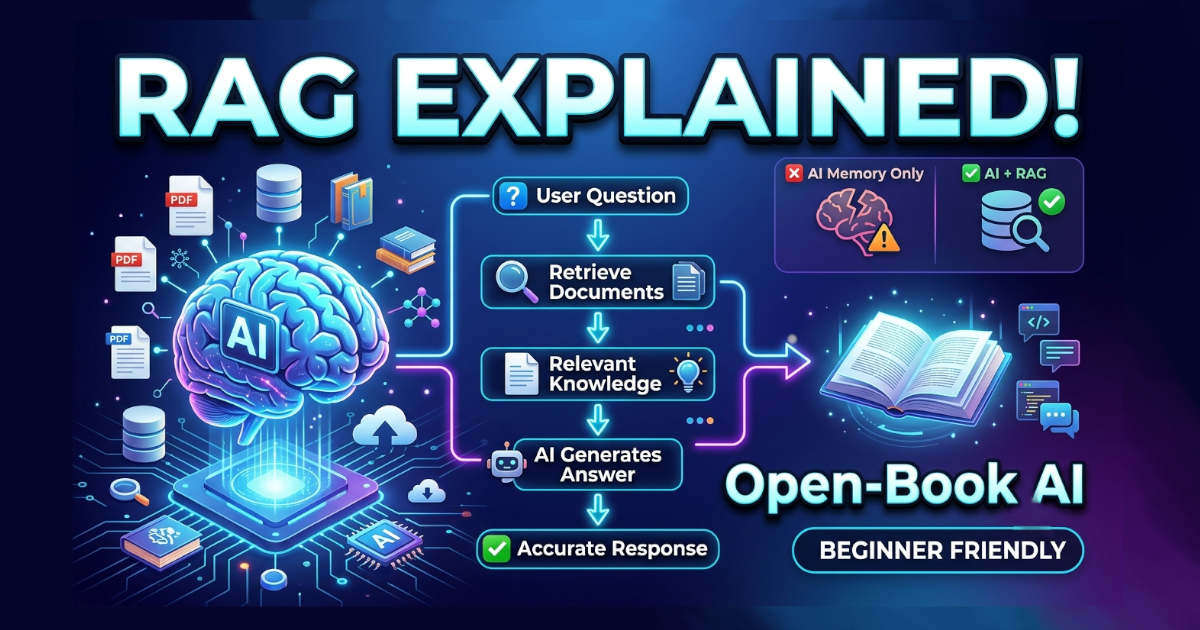
RAG (Retrieval-Augmented Generation) is a technique that allows an AI model to look up information before answering a question.
Instead of answering only from what it learned during training, the AI first searches relevant documents, retrieves useful information, and then uses that information to generate a better answer.
Think of it as giving the AI an open-book exam instead of a closed-book exam.
That's really all RAG is.
Let's Start with a Real-Life Example
Imagine you have a math exam tomorrow.
Someone asks:
"What is the derivative of x²?"
Would you memorize your entire textbook before answering?
Probably not.
Most people would:
Open the textbook.
Find the correct chapter.
Read the explanation.
Answer the question.
That's exactly what RAG does.
Instead of depending entirely on memory, it looks up the right information first.
Why Isn't AI Memory Enough?
Many beginners assume AI models know everything.
They don't.
Large Language Models (LLMs) like ChatGPT, Gemini, Claude, and Llama learn from enormous amounts of training data.
But they have limitations.
For example:
They don't know documents created after they were trained.
They don't automatically know your company's internal documentation.
They don't know your personal notes.
They may forget specific facts.
Sometimes they confidently generate incorrect information.
These incorrect answers are called hallucinations.
What Are Hallucinations?
A hallucination happens when an AI generates information that sounds convincing but is actually wrong.
For example:
Question
What is the vacation policy in my company?
Without RAG, the AI might invent a policy because it has never seen your company's handbook.
With RAG, it first searches the employee handbook and then answers using the actual policy.
Much safer.
Why Was RAG Created?
RAG solves several important problems.
Instead of forcing an AI to memorize everything in the world, we let it retrieve only the information it needs.
This provides several benefits:
More accurate answers
Access to up-to-date information
Ability to use private company documents
Fewer hallucinations
Better transparency because answers come from real sources
This is why many production AI systems rely heavily on RAG.
How RAG Works
Although "Retrieval-Augmented Generation" sounds complicated, the workflow is surprisingly straightforward.
It usually consists of three main steps.
Step 1: Someone Asks a Question
Everything begins with a user's question.
For example:
How do I reset my company VPN password?Or:
Explain Rust ownership.Or:
What are the side effects of this medicine?Nothing unusual happens here.
The user simply asks a question.
Step 2: Retrieve Relevant Information
This is where RAG becomes different from a normal chatbot.
Instead of answering immediately, the AI first searches a knowledge source.
That source might be:
PDFs
Documentation
Books
Company wikis
Databases
Research papers
APIs
Support articles
Websites
The goal is simple:
Find only the information related to the user's question.
Imagine searching a library.
You don't read every book.
You find the few pages that contain the answer.
That's retrieval.
Step 3: Generate the Answer
Once the relevant information has been found, the AI reads it and writes a natural response.
Notice something important.
The AI does not simply copy and paste the documents.
Instead, it:
understands the retrieved information,
combines useful details,
removes unnecessary parts,
explains everything clearly.
This is called generation.
The AI generates a brand-new answer using the retrieved context.
A Complete Example
Suppose you built a chatbot for your company's HR department.
An employee asks:
How many paid vacation days do I get?Without RAG:
The AI guesses.
It might say:
Employees receive 20 vacation days.
That answer could be completely wrong.
With RAG:
Step 1:
The employee asks the question.
↓
Step 2:
The AI searches the employee handbook.
↓
Step 3:
It finds:
Full-time employees receive 25 paid vacation days annually.↓
Step 4:
The AI replies:
Full-time employees receive 25 paid vacation days per year according to the employee handbook.
Much better.
Where Is RAG Used?
RAG powers many modern AI applications.
Some common examples include:
AI customer support
Company knowledge assistants
Documentation chatbots
Medical assistants
Legal document search
Coding assistants
Research assistants
Educational platforms
Enterprise search systems
Whenever AI needs accurate, up-to-date, or private information, RAG is often involved.
What Makes RAG Better Than Traditional AI?
Let's compare them.
Traditional AIAI with RAGAnswers from memoryLooks up information firstMay use outdated knowledgeCan use the latest documentsHigher chance of hallucinationLower chance of hallucinationCannot access private files by defaultCan search company documentsLimited by training dataExtended with external knowledge
This is why RAG has become one of the most popular architectures for AI applications.
Does RAG Eliminate Hallucinations Completely?
No.
This is a common misconception.
RAG reduces hallucinations, but it does not eliminate them.
Problems can still happen if:
The wrong documents are retrieved.
The documents contain incorrect information.
The retrieved context is incomplete.
The AI misunderstands the retrieved text.
Good retrieval is just as important as good generation.
Why Is Everyone Learning RAG?
Because modern AI applications rarely rely on language models alone.
Companies want AI that can:
answer questions about their products,
search internal documentation,
understand private knowledge,
stay up to date without retraining huge models.
RAG solves these problems efficiently.
That's why it's one of the most valuable skills in AI engineering today.
Summary
Retrieval-Augmented Generation sounds complicated, but the core idea is surprisingly simple.
Instead of answering immediately from memory, an AI first retrieves relevant information from trusted sources and then generates a response using that information.
Just like a student taking an open-book exam, the AI looks up the correct material before answering. This approach leads to more accurate, up-to-date, and trustworthy responses while reducing the chance of hallucinations.
Once you understand this simple workflow, the intimidating name "Retrieval-Augmented Generation" becomes much easier to remember.
Key Takeaways
RAG stands for Retrieval-Augmented Generation.
Think of RAG as giving AI an open-book exam.
The workflow is simple:
Receive a question.
Retrieve relevant information.
Generate an answer using that information.
RAG helps AI use current, private, and domain-specific knowledge.
It significantly reduces hallucinations but does not remove them completely.
The quality of the retrieved information directly affects the quality of the final answer.
RAG is widely used in modern AI assistants, enterprise search, documentation chatbots, coding tools, and research applications.