Maya just trained a machine learning model. She needs an API in front of it, and she needs it soon. Ratul is three weeks from launching a SaaS product. Next.js frontend, small team, everyone writes TypeScript.
Both asked me the same question last month: "FastAPI or Express?"
I gave them opposite answers. And neither answer had anything to do with benchmarks.
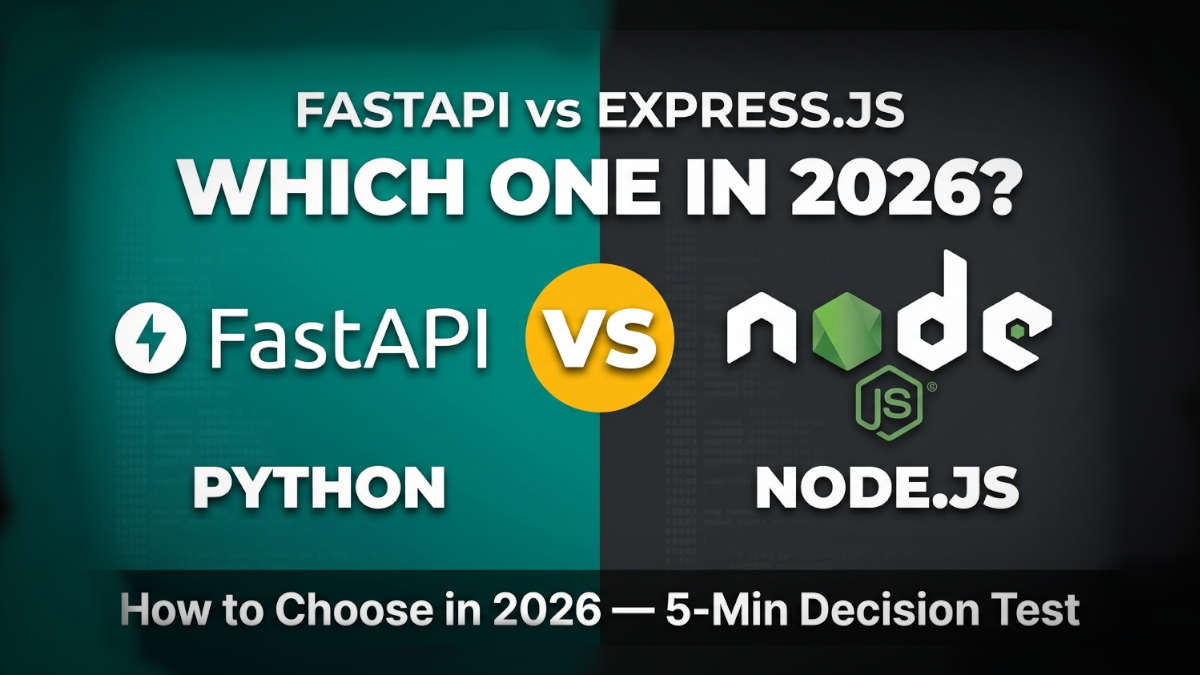
That's the first thing you need to understand about choosing between FastAPI and Express.js in 2026. It's not a performance question. It never really was.
So what is it about? Team language. Product roadmap. How much structure you want handed to you versus built by hand.
By the end of this article, you'll know exactly which framework fits your situation. There's a five-minute decision test near the end, if you're in a rush, skip straight to it.
Quick Answer: FastAPI or Express.js?
In a hurry? Here's the short version.
Pick FastAPI if:
Your team already writes Python
Your product touches AI, ML, or heavy data work
You want validation and API docs handled for you
You're building internal services or backend APIs
Pick Express.js if:
Your team lives in JavaScript or TypeScript
You're building real-time stuff, chat, live dashboards, notifications
You plan to deploy to serverless or edge platforms
You want one language across the whole stack
That's the gist. Now let's look at why.
What You're Actually Comparing
Two frameworks. Two completely opposite philosophies.
FastAPI is the young one. It's built on Starlette and Uvicorn, the Python ASGI stack, and its whole identity is "batteries included." You write type hints, and it hands you validation, serialization, and auto-generated Swagger docs. Free. It hasn't even hit version 1.0, yet it's taken over the Python API world. These days it even has more GitHub stars than Express.
Express.js is the opposite animal. Over a decade old, battle-tested, and deliberately tiny. It gives you routing and middleware. Everything else, validation, auth, docs, project structure, you assemble yourself. Express 5 finally went stable in 2025, and it fixed the async error handling that used to silently swallow errors in Express 4. Long overdue.
One framework makes decisions for you. The other makes you make them.
Almost everything below flows from that one difference.
FastAPI vs Express.js at a Glance
Factor | FastAPI | Express.js |
|---|---|---|
Language | Python | JavaScript / TypeScript |
Runtime | ASGI (Uvicorn) | Node.js event loop (libuv) |
Validation | Built-in (Pydantic v2) | DIY (Zod, Joi, express-validator) |
API docs | Auto-generated Swagger + ReDoc | Manual or third-party |
Type safety | Native, enforced at runtime | Optional (TypeScript + Zod) |
Real-time / WebSockets | Supported, thinner ecosystem | Excellent (socket.io, ws) |
AI / ML ecosystem | Excellent, native Python | Limited, needs a sidecar service |
Edge / serverless deploys | Not realistic | Excellent, millisecond cold starts |
Learning curve | Moderate (Pydantic mental model) | Low to start |
License | MIT | MIT |
With that on the table, here are the factors that should actually drive your choice.
Factor 1: Your Team's Language Beats Every Benchmark
Most comparisons bury this at the bottom. I'm putting it first, because it settles the question for most teams before a single benchmark gets read.
If your team writes JavaScript all day, switching to Python for a marginal performance gain is almost always a mistake. Context switching costs real money. Code reviews slow down. Onboarding takes longer. And bugs love to hide in the language nobody on the team knows deeply.
Works the other way too. Got data scientists or ML engineers on the team? Forcing them into JavaScript is fighting your own people.
So before anything else, answer honestly: what does your team already write well?
For a lot of you, that's the whole answer. You can stop reading now, but the next sections explain why this factor outweighs everything else, so stick around if you're on the fence.
Factor 2: Performance, What the Benchmarks Don't Tell You
Yes, Node.js frameworks usually win synthetic benchmarks like TechEmpower. Sometimes by a wide margin on plaintext JSON tests. That part is real.
But look at what those benchmarks actually measure: a framework doing almost nothing. Your API isn't doing almost nothing. It's querying a database. Calling third-party services. Reading from a cache.
And when an API spends most of its life waiting on I/O, both frameworks wait equally well. FastAPI's async I/O and Express's event loop are non-blocking by design. Same job, same patience. In real-world workloads, the framework difference is basically noise.
Where Express genuinely wins: raw throughput on lightweight endpoints, and anything latency-obsessed, think high-frequency trading systems.
Where FastAPI struggles: CPU-bound pure Python code can block the event loop. The fix is offloading work to workers or using libraries like NumPy that release the GIL. Known pattern, but it's extra complexity you have to manage.
Where FastAPI quietly wins: Pydantic v2's validation core is written in Rust, so request validation runs at near-native speed. And its multi-worker model makes capacity planning more predictable under load.
My honest take? For the vast majority of projects, performance shouldn't decide this at all. Measure your actual bottleneck. Nine times out of ten it's your database, not your framework.
Factor 3: Type Safety and Validation, Built-In vs DIY
Here's where the two philosophies clash hardest.
With FastAPI, validation is the default. You declare a Pydantic model, and every incoming request gets checked automatically. Bad input dies before it touches your business logic. Missing field? Wrong type? You get a structured error, not a mystery bug at 2 a.m.
With Express, validation is your job. You add Zod or Joi, write the schemas, and, this is the part that bites people, you have to actually call them in every single route. Small team, good discipline? Fine. Under deadline pressure? Coverage gets patchy. And one skipped schema check on one forgotten route is a classic production crash story.
Now let me kill a misconception while I'm here. JavaScript developers often assume Python is "loosely typed." At the API boundary, reality is closer to the reverse. FastAPI + Pydantic rejects bad input at runtime. TypeScript's types? They vanish at runtime. Compare the full stacks fairly, FastAPI + Pydantic against Express + TypeScript + Zod, and they're close. But FastAPI enforces it by default. Express hopes you remembered.
Edge: FastAPI, especially for larger teams, growing codebases, or anything handling sensitive data.
Factor 4: Developer Experience and Learning Curve
Express is faster to start. A JavaScript developer follows a tutorial and has a working API the same afternoon. The middleware model is simple, and every Node.js developer already knows it. That's not a small thing.
FastAPI takes maybe a day longer to click. The Pydantic, model-driven approach is the reason. But that day pays you back:
Your API documents itself (more on this below)
IDE autocomplete actually works, because everything is typed
Dependency injection through
Depends()keeps code testableEvery endpoint follows the same pattern, so the codebase stays readable
Express's freedom has a flip side, though. You pick the validation library. You pick the router, the ORM, the auth approach. That flexibility is Express's identity, and it's also why two Express codebases from two different teams can look like entirely different languages.
One more thing worth knowing: teams that outgrow bare Express often move to NestJS. It's built on Express, so you keep the ecosystem, but you gain structure and dependency injection similar to what FastAPI gives you. Common path for bigger teams, and a sensible one.
Edge: Express for speed to first deploy. FastAPI for long-term structure.
Factor 5: The Ecosystems, AI vs Real-Time and Edge
This is the part that's actively reshaping the debate in 2026.
FastAPI's killer advantage: AI
PyTorch. Hugging Face Transformers. LangChain. LlamaIndex. They all live in Python.
If your product calls an LLM, runs inference, or processes data with ML, FastAPI means your model and your API share one runtime. That's it. That's the whole argument.
Doing the same from Express means spinning up a separate Python sidecar service, a network hop, double serialization, two systems to monitor. It works. But you'd be paying a permanent tax just to avoid Python.
And in 2026, "we might add AI features" has quietly become "of course we're adding AI features." That shift matters.
Express's killer advantage: real-time and edge
Building chat, live feeds, multiplayer, or collaborative tools? socket.io on Express is genuinely excellent. Heartbeats, rooms, reconnection logic , handled out of the box. FastAPI supports WebSockets, but the surrounding real-time ecosystem is much thinner.
Express also deploys where FastAPI can't follow. Small Express handlers run on serverless and edge platforms with millisecond cold starts. FastAPI needs a container or a server, and its cold starts are measured in seconds. If your architecture lives on Cloudflare Workers or Vercel Edge, you have your answer already.
Neither ecosystem is "better." They're better at different things. Match the ecosystem to your roadmap, and the framework picks itself.
Factor 6: Documentation and Long-Term Maintenance
Small factor. Huge consequences later.
FastAPI generates interactive Swagger docs straight from your code. Zero config. Your frontend team sees every endpoint and response shape without pinging you once. And because the docs come from the source of truth, they can't drift.
With Express, you wire up swagger-jsdoc, write annotations by hand, and hope nobody forgets to update them. In my experience, hand-maintained docs always drift eventually. Always.
If outsiders consume your API... mobile apps, third parties, other companies, this factor alone can justify FastAPI.
My FastAPI vs Express Scorecard
My subjective ratings, based on everything above. Yours may differ... this is judgment, not math.
Criterion | FastAPI | Express.js |
|---|---|---|
Raw performance | 8/10 | 9/10 |
Real-world API performance | 9/10 | 9/10 |
Type safety out of the box | 9/10 | 6/10 |
Learning curve | 7/10 | 9/10 |
AI / ML ecosystem | 10/10 | 5/10 |
Real-time / WebSockets | 7/10 | 10/10 |
Auto-generated docs | 10/10 | 4/10 |
Edge / serverless | 4/10 | 9/10 |
Ecosystem maturity | 8/10 | 10/10 |
See the pattern? Express wins the raw numbers. FastAPI wins almost everything that happens around your code, validation, docs, AI, long-term sanity.
The 5-Minute Decision Test
Here's exactly how I'd decide, fast.
Question 1: What language does your team already write well?
Python → FastAPI. Done, don't overthink it.
JavaScript or TypeScript → Express. Also basically done.
Question 2: Comfortable in both? Then, does your 12-month roadmap include AI or ML features, even as a "maybe"?
Yes → FastAPI. Retrofitting AI onto a JavaScript backend later is painfully expensive.
No → next question.
Question 3: Are you building real-time features, or deploying to edge/serverless?
Yes → Express, or a modern Node framework.
No → it's a standard REST API with a database → FastAPI, for the built-in validation and docs.
That's the whole test. Three questions, and they cover the situations people actually face.
4 Mistakes People Make When Choosing
I keep seeing these four. Avoid them and you're ahead of most teams already.
1. Choosing from synthetic benchmarks.
Express wins hello-world tests, so people pick it for an API that spends its whole life waiting on database queries. Benchmark your bottleneck, not your framework.
2. Assuming Python means weak typing.
FastAPI with Pydantic is stricter at runtime than TypeScript with no validation library. Compare full stacks, not languages.
3. Starting with Express, bolting AI on later.
The 2026 version of technical debt. If AI is even a "maybe" on your roadmap, that future sidecar architecture will cost you far more than learning Python ever would.
4. Using FastAPI without understanding async Python.
Write a blocking database call inside an async route, and you block the event loop, killing FastAPI's entire advantage. Use async libraries like asyncpg and httpx in async handlers. This is the single most common FastAPI production mistake I know of.
My Verdict: Which One I'd Pick in 2026
You've seen the full comparison. Here's my call.
Starting a brand-new backend project today, with no existing team constraints? I'd pick FastAPI.
Three reasons.
Validation and docs come free. Express makes me assemble those myself, and assembling things correctly under deadline pressure is exactly where teams slip.
The industry is moving toward AI, hard. FastAPI puts me one import away from the entire Python ML ecosystem. Express puts me one sidecar service away. I know which position I'd rather be in.
And it scales with the team. Typed endpoints, generated docs, forced patterns, that's what keeps a codebase sane as more people touch it.
But. If I were joining or leading a JavaScript-first team, I would not pick FastAPI. Shipping a SaaS product next quarter, everyone fluent in TypeScript? Express + TypeScript + Zod, no hesitation. A good stack your team knows beats a "better" stack nobody knows. And for real-time products or edge deployments, Express isn't the compromise. It's the right answer.
There's a third option people forget, too: use both. FastAPI for AI and data services, Express for real-time and customer-facing routes. Two runtimes to manage, so don't do it by default, but for products with genuinely split workloads, it's a legitimate architecture, not a cop-out.
Which Framework Is Right for You?
Your situation | My pick |
|---|---|
Python team, or building AI/ML products | FastAPI, no debate |
JavaScript/TypeScript team shipping a product | Express (+ TypeScript + Zod) |
Real-time app: chat, live feeds, multiplayer | Express with socket.io |
Data pipeline or internal typed API | FastAPI |
Edge/serverless-heavy architecture | Express or a modern Node framework |
Enterprise, 20+ engineers on the JS side | NestJS for structure, FastAPI for data/ML services |
Total beginner, no language preference | Express to start faster, or FastAPI if AI is your destination |
Conclusion
The FastAPI vs Express.js decision was never about which framework is faster. Both are excellent, and both will comfortably handle more traffic than most products ever see.
It's about your team's language. Your product's roadmap. And how much you want built in versus assembled by hand.
Answer those three questions honestly, and the right choice stops being a debate.
Choose for the next three years, not for the next benchmark.