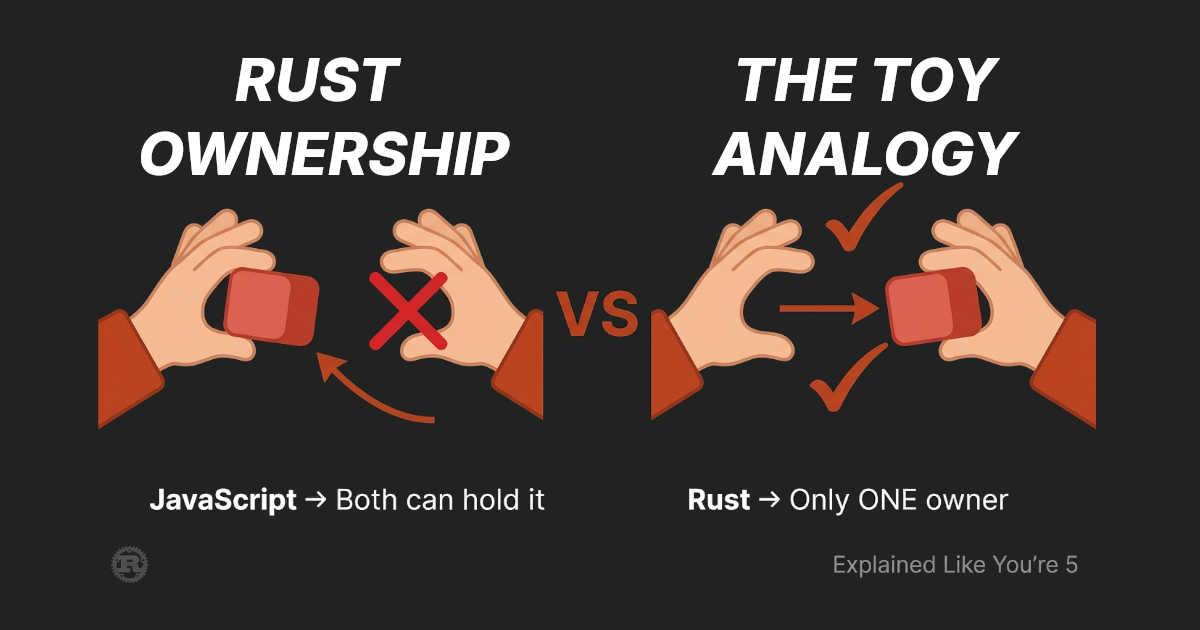
Picture your favorite toy. Now imagine someone tells you, you can only have one favorite toy at a time. Give it away, and it's not yours anymore. That's Rust ownership in a nutshell. And yeah, it's the reason Rust can clean up memory without a garbage collector.
If you come from JavaScript, you probably never think about who "owns" your variables. The GC just handles it. Rust doesn't work like that. It makes ownership a real thing, checks it when you compile, and uses it to free memory for you.
Let's walk through this step by step. By the end, you'll get why Rust folks keep saying "moved value" and why you can't touch a variable after you hand it off.
Read post on "How to Choose Between FastAPI and Express.js in 2026"
The Problem Ownership Fixes
Every program deals with memory. You make data, the computer gives you memory. When the data's done, that memory should go back.
Different languages do this in different ways.
JavaScript uses a garbage collector. You make stuff, and when nothing points to it anymore, some background process cleans it up. Easy, but it's not free. GC pauses, unpredictable timing, extra memory overhead, all real things.
C and C++ make you do it yourself. You call malloc, you call free. Total control, but also total responsibility. Forget to free? Memory leak. Free twice? Crash. Use it after freeing? Good luck.
Rust does something else. It uses ownership rules the compiler checks for you. The compiler knows exactly when your data is done, and it inserts the cleanup code. No GC. No manual free. Just some rules you follow, and the compiler handles the rest.
Read article on "Beyond Try/Catch"
What Ownership Actually Is
Ownership in Rust is just three rules:
Every value has one owner. That owner is the variable holding it.
Only one owner at a time. No sharing.
When the owner goes out of scope, the value gets dropped.
If you're from JS, that third rule is the one that hits different. When a variable goes out of scope in Rust, Rust calls drop() on it. Memory freed. Done.
Let's see it:
rust
fn main() {
    {
        let message = String::from("Hello, Rust!");
        println!("{}", message);
    } // message is dropped right here
}
That String lives inside the block. Block ends, message is gone. Rust doesn't need to search for it later. No GC sweep. No free() call. It just happens.
Learn about "7 Developer Tools That Are Loved and Hated at the Same Time"
Moves: The "Oh, I Get It" Moment
Here's where things get interesting.
In JavaScript you can do this:
javascript
let a = { value: 42 };
let b = a;
// a and b both point to the same object
Rust doesn't play that game. Not for heap types like String:
rust
let first_owner = String::from("Secret data");
let second_owner = first_owner;

println!("{}", second_owner); // fine
// println!("{}", first_owner); // nope. moved value.
What just happened? When you assign first_owner to second_owner, Rust doesn't copy the string. It moves ownership. The first variable becomes invalid.
Why not copy? Because copying could be slow. Imagine a string with a whole book in it. Duplicating that every time you assign it would be nuts. Rust's rule is: automatic stuff should be cheap. Moving a String just copies a pointer, a length, and a capacity. Three small things on the stack. The actual text stays where it is on the heap.
Here's the memory picture:
text
Stack:                    Heap:
first_owner:
  ptr ──────────────────> "Secret data"
  len: 11
  capacity: 11

After move:
second_owner:
  ptr ──────────────────> "Secret data"  (same spot)
  len: 11
  capacity: 11

first_owner: (dead. compiler won't let you use it)
Why Rust Is So Strict About This
The restriction feels annoying at first. Why can't I use first_owner after the move?
Because of double-frees. If both variables were still valid, both would try to free the same memory when they went out of scope. That's a double-free. It's a nasty bug. Can corrupt memory. Can open security holes.
By killing the original variable after a move, Rust makes sure only one thing is responsible for cleanup. The compiler catches the problem before your code even runs.
Copy Types: When Moves Don't Apply
Not everything works like this. Simple stuff, integers, booleans, floats, implements the Copy trait. Those live on the stack. Copying them is cheap.
rust
let x = 5;
let y = x; // x is copied, not moved

println!("x is {}, and y is {}", x, y); // both still work
Copy just tells Rust: this type can be duplicated with a simple bitwise copy. No heap allocation, no problem. Both variables get their own copy.
Heap types like String and Vec do not implement Copy. They get moved.
Moving Into Functions
Functions move things too. Pass a value by value, you're giving ownership to that function:
rust
fn consume_string(s: String) {
    println!("I own: {}", s);
} // s dropped here

fn main() {
    let my_string = String::from("Hello");
    consume_string(my_string);

    // println!("{}", my_string); // error. moved.
}
consume_string takes ownership. After the call, my_string is dead. Feels restrictive, right? But it's actually useful. You know exactly which function is on the hook for cleanup.
The into_ Naming Thing
Rust has a convention for methods that take ownership. They use into_:
rust
let s = String::from("hello");
let bytes: Vec<u8> = s.into_bytes(); // s is gone now
into_ means: this takes ownership. Compare it with as_ (borrows) or to_ (allocates something new). Following this convention makes your API predictable. People know what they're giving up when they call your method.
Scope: Where Cleanup Happens
The real magic is scope. Every variable has one. When the scope ends, Rust calls drop() and frees the memory.
rust
fn main() {
    let outer = String::from("I live in main");

    {
        let inner = String::from("I live in the inner block");
        println!("{}", inner);
    } // inner dropped here

    println!("{}", outer); // outer still fine
} // outer dropped here
This is deterministic. Unlike GC, which runs whenever it feels like it, Rust drops happen exactly when scope ends. Predictable. Efficient.
Ownership and Threads
Ownership also saves you from data races. When you send a value to another thread, you move it:
rust
use std::thread;

fn main() {
    let data = String::from("Hello from main");

    let handle = thread::spawn(move || {
        println!("{}", data); // this thread owns data now
    });

    // println!("{}", data); // error. moved into the thread
    handle.join().unwrap();
}
The move keyword forces the transfer. Main thread can't touch data anymore. No data race possible.
You Need References Too
Pure ownership would be painful. Every function call would mean giving up your data forever. That's where references come in.
rust
fn calculate_length(s: &String) -> usize {
    s.len()
} // s is just a reference. nothing dropped.

fn main() {
    let my_string = String::from("Hello");
    let len = calculate_length(&my_string);

    println!("The length of '{}' is {}", my_string, len); // still mine
}
The & makes a reference. The function borrows the string, uses it, gives it back. The owner never loses ownership.
Borrowing has its own rules (that's a whole other post). But ownership is the base layer. Borrowing builds on it.
Mistakes People Make
Using a Variable After Moving It
rust
let s1 = String::from("hello");
let s2 = s1;
println!("{}", s1); // error: use of moved value
Fix: Clone it (s1.clone()) or restructure so you don't need s1 after.
Moving Out of a Reference
rust
let v = vec![String::from("hello")];
let s_ref = &v[0];
let s = *s_ref; // error: cannot move out of a shared reference
Fix: Clone it (v[0].clone()) or use remove if you actually want it out.
Forgetting Copy Types Are Different
rust
let x = 5;
let y = x;
println!("{}", x); // works fine. i32 is Copy.
Good and Bad
Good | Bad |
|---|---|
No GC pauses | Learning curve is real |
Deterministic cleanup | Move rules feel weird at first |
Compile-time double-free prevention | Sometimes you have to restructure code |
Ownership is explicit in APIs | Borrow checker can be frustrating |
Safe concurrency | Doesn't stop every memory leak (cycles) |
Where You'll Actually Use This
Systems programming. OS stuff, embedded, anything where GC overhead is a no-go.
WebAssembly. Rust's small runtime is perfect for WASM.
CLI tools. Fast startup, low memory.
Network services. No GC pauses killing your latency.
Game engines. Real-time performance matters.
Ownership Doesn't Stop Everything
Ownership stops a lot of bugs. But not all leaks. Reference cycles still leak:
rust
use std::rc::Rc;
use std::cell::RefCell;

struct Node {
    next: Option<Rc<RefCell<Node>>>,
}

// A -> B -> A cycle
let a = Rc::new(RefCell::new(Node { next: None }));
let b = Rc::new(RefCell::new(Node { next: Some(Rc::clone(&a)) }));
a.borrow_mut().next = Some(Rc::clone(&b));
// neither drops. they reference each other.
Rust gives you Weak<T> to break cycles. But the point is: ownership prevents accidental leaks, not structural ones you build on purpose.
FAQ
Does Rust still have a garbage collector?
No. Ownership plus the compiler handles memory. No runtime GC.
Can I just skip ownership rules?
Not really. Rc and Arc give you shared ownership, but they're built on top of the ownership system. No full escape.
Can I just clone everything?
You can. But cloning isn't free. Do it when you actually need two copies.
How is this different from C++ RAII?
Same idea, cleanup on scope exit. But Rust adds move semantics and borrow checking on top. C++ doesn't have those compile-time guarantees.
Does ownership apply to all types?
Heap types follow it strictly. Stack types like integers are Copy and just get duplicated.
What to Learn Next
Ownership is the base. Next up:
Borrowing and references, how to use data without taking it.
Lifetimes, how Rust tracks how long references live.
Smart pointers, Box, Rc, Arc, RefCell for when single ownership isn't enough.
The Drop trait, custom cleanup for your own types.
Best way to learn? Write tiny programs. Move stuff around. Break things. Read the compiler errors. They're not obstacles, they're the ownership system teaching you how memory really works. Every error is a free lesson.