I still remember the day I finally got why some websites feel slow, even on fast Wi-Fi. It wasn't about my internet connection at all. It was about how the internet actually works behind the scenes.
I was staring at a network waterfall chart, basically a timeline of how a webpage loads, and I noticed something strange. One tiny piece of data got lost. Just one. And suddenly, everything else stopped too.
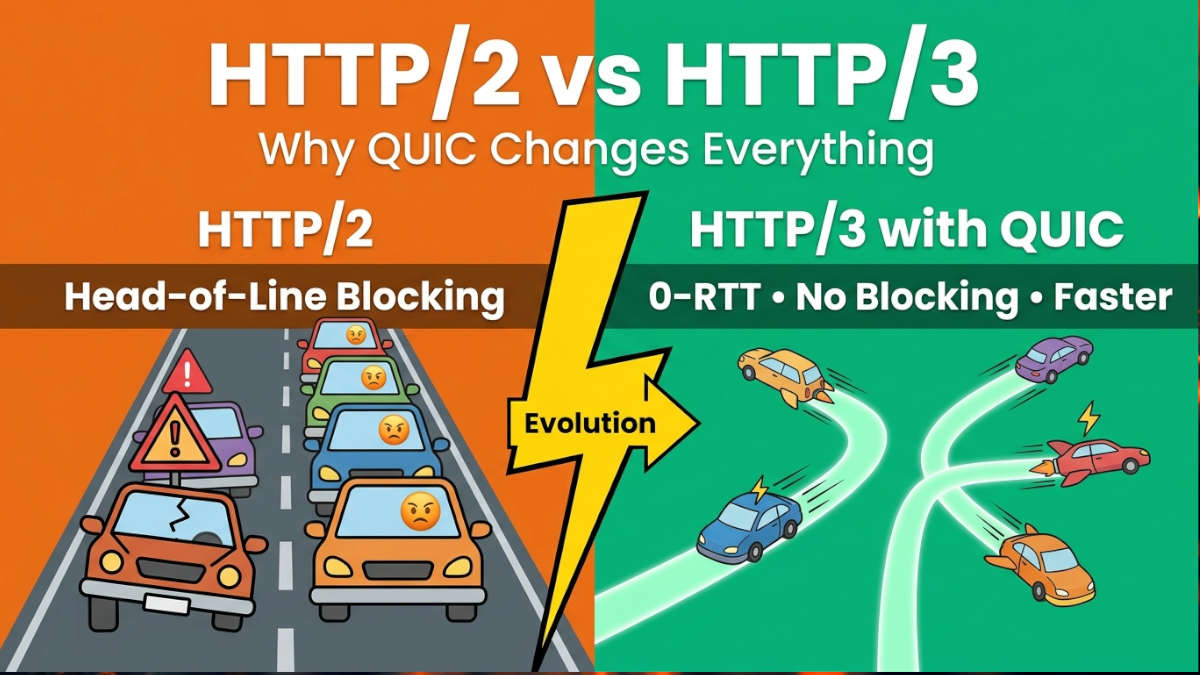
It was like sitting in traffic. A single stalled car in the front lane was blocking the entire highway. Nobody could move.
That moment changed how I see the web.
That is the old world of HTTP/2. And after diving deep into the future, I want to tell you about HTTP/3 and why its engine, called QUIC, is changing everything.
Let me walk you through what I’ve learned, comparing the two protocols simply, and I’ll share what I would do if I had to choose today.
The Big Problem with the "Old" Way (HTTP/2)
Before we can understand why QUIC is such a huge deal, we have to talk about the foundation. For decades, the web has been built on a system called TCP (Transmission Control Protocol). Think of TCP as a super strict, rule-following delivery driver.
It ensures that every single package gets to its destination, in the exact right order. That sounds great, right? Reliable. But here is the catch: if just one package gets lost or delayed on the road, the whole delivery line stops.
In tech terms, we call this Head-of-Line Blocking.
Imagine you are loading a web page with 20 different images. With HTTP/2, these images can all be sent over a single, efficient connection. It was a massive improvement over the old days. But because TCP insists on order, if the data packet for "Image 1" gets lost, the browser can't use the packets for "Image 2" or "Image 3" even if they have already arrived.
They just sit there, waiting. It’s that stalled car blocking the highway again.
Enter HTTP/3 and QUIC: The Game Changer
This is where the title of this article comes into play. HTTP/3 doesn’t use TCP. It uses a new transport protocol called QUIC (Quick UDP Internet Connections), which runs on top of UDP.
UDP is like the wild, carefree cousin of TCP. It just throws packets out there without checking if they arrive. On its own, UDP is often used for live video calls where speed matters more than perfection. But the engineers behind QUIC were smart. They took the speed of UDP and added all the safety and security features on top of it.
They built a system that gives you the best of both worlds: the speed of UDP and the reliability of TCP, without the traffic jams.
Here is a simple breakdown of the protocol stacks:
HTTP/2 Stack:                     HTTP/3 Stack:
+------------------+              +------------------+
|       HTTP       |              |       HTTP       |
+------------------+              +------------------+
|    TLS 1.2+      |              |   QUIC (Handles  |
+------------------+              | Security & Flow) |
|       TCP        |              +------------------+
+------------------+              |       UDP        |
|        IP        |              +------------------+
+------------------+              |        IP        |
                                  +------------------+
Notice how QUIC is almost like a "Super UDP." It handles the security and the ordering, but it does it smarter than TCP.
The Head-to-Head: HTTP/3 vs HTTP/2
Let’s look at the key differences in a way that actually matters for your website and your users.
1. The "Traffic Jam" Solution (Multiplexing)
HTTP/2: Imagine a single road with multiple lanes. Cars (data streams) can travel in parallel. But if one car crashes (packet loss), the police block the entire road to clean it up. All lanes stop.
HTTP/3 with QUIC: Now imagine those cars can fly. They are independent. If the green car crashes, it doesn’t affect the yellow car at all. The yellow car continues to its destination instantly.
This is the killer feature. It means on a shaky mobile network, your website doesn't grind to a halt just because a few packets got lost.
2. Saying "Hello" Faster (Connection Speed)
Whenever your browser connects to a server, they need to do a "handshake" to say hello and set up security. It’s like calling a friend: you have to wait for them to pick up and say "Hello?" before you start talking.
HTTP/2 (TCP + TLS): This often takes two or three round trips before any real data is sent. More round trips = more waiting.
HTTP/3 (QUIC): QUIC combines the "Hello" (transport) and the "Security Check" (TLS) into a single step. And for repeat visitors, it supports something called 0-RTT (Zero Round Trip Time). This means if you have visited the site before, the browser can start sending requests immediately, without waiting for a single "Hello."
The result? According to some tests by Cloudflare, HTTP/3 saw the first byte of data arrive 12.4% faster than HTTP/2.
3. Switching Networks Without Dropping the Call (Connection Migration)
This is a huge one for mobile users. Have you ever been on a video call while leaving your house Wi-Fi, and it freezes for a second as your phone switches to cellular data?
That’s because a TCP connection is tied to your IP address. When your IP changes, the connection breaks, and you have to start over.
HTTP/3 solves this. It uses a unique Connection ID instead of an IP address to identify the session. Think of it like your email address: you can move from your laptop to your phone, but your email address stays the same, so you keep getting your mail.
This means when your phone switches from Wi-Fi to 5G, the connection doesn't drop. The stream keeps flowing.
4. Security by Default
HTTP/2 allowed encryption, but it was technically optional. HTTP/3 doesn’t play games. It has TLS 1.3 (the latest security standard) built directly into QUIC.
This not only makes the web safer but also contributes to the speed benefits by eliminating the older, slower security negotiation methods. There is no "unencrypted" version of HTTP/3.
So, Is Everything Perfect Now? My Honest View
Okay, I have to be honest with you. If I stop here, it sounds like HTTP/3 is a perfect 10/10. But based on the real-world data I've seen, that’s not the whole story yet.
The theory is perfect. But the implementation is still catching up.
In tests run by Cloudflare, they found something interesting:
For a small website (15KB), HTTP/3 was faster. It loaded in 443ms compared to 458ms for HTTP/2.
However, for a larger website (1MB) , HTTP/3 was actually a tiny bit slower, taking 2.33 seconds compared to 2.30 seconds for HTTP/2.
Why? The answer is Congestion Control—the algorithms that decide how fast to send data to avoid overwhelming the network. The HTTP/2 stacks have had years of tuning. The HTTP/3 algorithms are still relatively new and are being optimized. It’s like a brand new race car engine; the design is superior, but it hasn’t been tuned for the track yet.
What Would I Do to Choose? (My Verdict)
So, what do I tell a developer or a business owner who asks me, "Should I switch to HTTP/3?"
Here is my advice based on what I’ve seen:
1. Turn It On Now, If You Can.
The absolute worst-case scenario is that your performance is roughly the same as HTTP/2. The best-case scenario is that you see immediate gains, especially if your users are on mobile devices or live far from your servers. The protocol is designed to handle our messy, mobile-first world.
2. Know Your Audience.
If you are building a real-time game, a video conferencing app, or serving users on unstable networks (like commuters on a train), HTTP/3 is a no-brainer. The connection migration and lack of head-of-line blocking are game changers for these users.
If you are serving a simple, stable desktop application on a corporate network, HTTP/2 is still perfectly fine for now. The "weaknesses" of HTTP/2 are less visible there.
3. Prepare for the Future.
Even though HTTP/2 is going to be around for a very long time, QUIC is undeniably the future. The internet is moving toward a world with more devices, more mobility, and more demand for speed. By adopting HTTP/3 today, you are ensuring your infrastructure is ready for what’s next.
I wouldn't look at this as an "either/or" choice. You don't necessarily need to rip out HTTP/2. The smart approach is to enable HTTP/3 on your servers (most major CDNs like Cloudflare make this a one-click setting) and let the users with modern browsers benefit from it. You are not leaving HTTP/2 behind; you are simply opening the door for the future.
The Final Word
HTTP/3 with QUIC feels like the first real evolution of the web's plumbing in decades. We’ve been putting patches on TCP for years, but QUIC is a foundational shift. It treats network interruptions as a fact of life rather than a crisis.
Watching the internet move from "stopping everything to fix a problem" to "skipping over the problem and moving on" is a beautiful thing. It makes the web feel faster, more resilient, and more human. And that is why QUIC changes everything.