
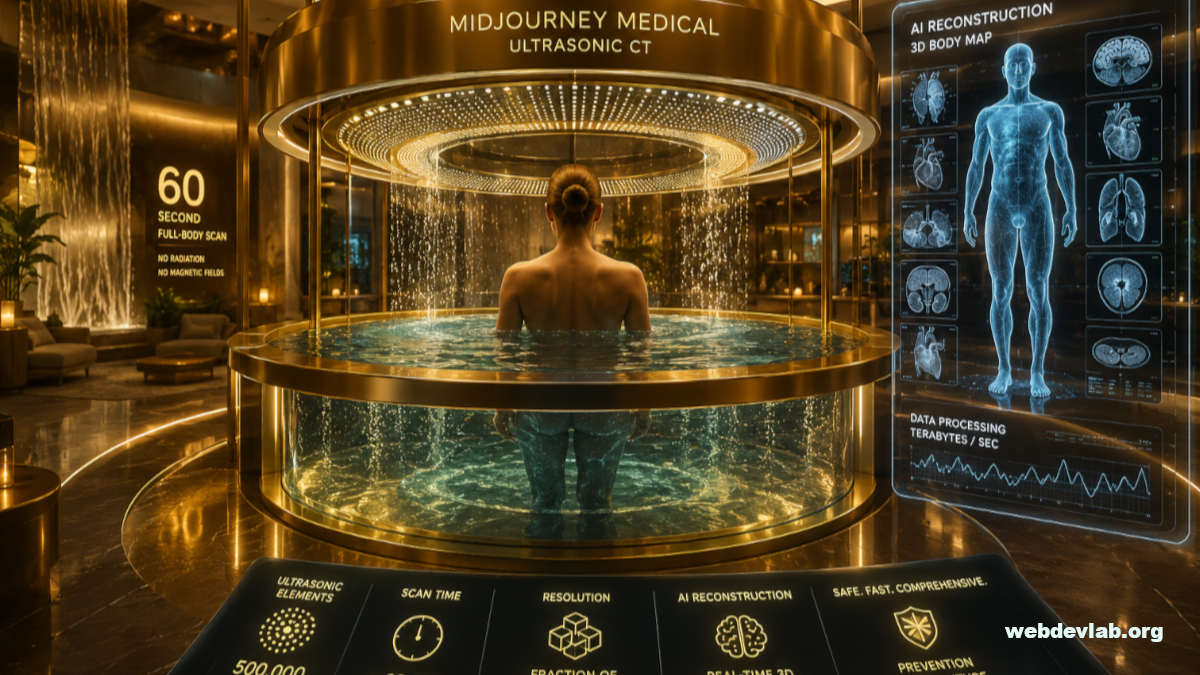
What if getting a full-body medical scan felt more like visiting a luxury spa than stepping into a hospital?
That's the future Midjourney is betting on.
The company best known for AI-generated images has announced Midjourney Medical, a new healthcare division developing what it calls "Ultrasonic CT", a full-body imaging system designed to create MRI-like scans in as little as 60 seconds without radiation or powerful magnetic fields. If Midjourney succeeds, it could reshape how people monitor their health, detect diseases earlier, and interact with preventive medicine. But while the vision is ambitious, many medical experts say the company still has a lot to prove.
Key Takeaways
Midjourney has launched a healthcare division called Midjourney Medical
Its new scanner aims to produce full-body imaging in under 60 seconds
The technology uses ultrasound instead of radiation or magnetic fields
The first public scanning spa is planned for San Francisco
Midjourney hopes to deploy 50,000 scanners worldwide by 2031
The company claims the technology could help reduce global deaths by 30% and healthcare costs by 50%
Medical imaging experts remain skeptical due to a lack of independent validation and peer-reviewed evidence
What Exactly Is Midjourney Building?
At its core, Midjourney is attempting something extraordinarily ambitious:
Create a medical imaging system that combines the accessibility of ultrasound with imaging quality approaching MRI—while being dramatically faster and potentially cheaper.
The system, branded Ultrasonic CT, is unlike traditional MRI or CT scanners.
Instead of lying inside a large magnetic machine, users stand on a platform and are gradually lowered into a shallow pool of water through a circular scanning ring.
As they move through the scanner, hundreds of thousands of ultrasonic sensors emit sound waves and record the echoes bouncing back from tissues throughout the body.
Midjourney says AI algorithms then reconstruct those signals into a detailed three-dimensional representation of the body.
According to the company, the result is:
Full-body imaging in under 60 seconds
No radiation exposure
No strong magnetic fields
Fraction-of-a-millimeter imaging detail
Potentially MRI-like visualization
The company describes the process as being surrounded by "half a million tiny dolphins" using echolocation simultaneously.
How the Scanner Works
ComponentDescriptionImaging MethodUltrasoundSensor CountApproximately 500,000 ultrasonic elementsScan DurationTarget of under 60 secondsMediumWater immersionData GeneratedTerabytes per secondOutputAI-generated 3D body modelRadiationNoneMagnetic FieldsNone
Why Water Matters
One of the most unusual aspects of Midjourney's scanner is the use of water.
Water acts as an efficient medium for transmitting ultrasonic waves throughout the body. By fully surrounding the person, the scanner can capture imaging information from multiple angles simultaneously.
The scanning ring itself reportedly contains around half a million microscopic ultrasound elements, each functioning as both:
A speaker emitting sound waves
A microphone receiving echoes
The company claims these sensors generate terabytes of imaging data every second, requiring AI systems to process and reconstruct the final images.
This approach is fundamentally different from traditional ultrasound exams, which typically depend on handheld probes operated by trained technicians.
From AI Art to Medical Imaging
Perhaps the most surprising aspect of the announcement is who is making it.
Midjourney built its reputation as one of the world's leading AI image-generation companies.
Medical imaging seems far removed from text-to-image generation.
The company openly acknowledges this shift, describing the project as part of a broader effort to determine what it wants to become in the future.
Unlike many technology startups, Midjourney says it is:
Privately funded
Community-supported
Free of outside investors
That independence has allowed the company to pursue long-term projects that may not fit traditional venture-capital timelines.
The Butterfly Network Partnership
While Midjourney is new to healthcare, it isn't building the scanner alone.
The project is being developed in collaboration with Butterfly Network, a company known for its ultrasound-on-chip technology.
Public reports indicate Midjourney signed an exclusive licensing and co-development agreement with Butterfly in late 2025.
Reported Financial Details
Agreement ElementReported ValueUpfront Payment$15 millionAnnual Licensing$10 millionMilestone PaymentsUp to $9 millionTotal Potential ValueUp to $74 million
The prototype scanner reportedly integrates dozens of Butterfly ultrasound modules into a single imaging system.
The Spa Strategy: Healthcare Meets Hospitality
Perhaps the most unconventional part of the project is not the scanner itself—it's where Midjourney plans to place it.
Rather than introducing scanners through hospitals or imaging centers, the company wants to launch health-focused spas.
Its first location is planned for Union Square in San Francisco, occupying approximately 23,000 square feet across four floors.
The experience is designed to feel closer to a luxury wellness retreat than a clinic.
Planned amenities include:
Hot tubs
Saunas
Cold plunges
Waterfalls
Ambient lighting
Full-body scanning pools
According to CEO David Holz, the goal is simple:
"I don't want to feel like I'm going to a doctor's office."
The facility is expected to operate around the clock and house multiple scanning systems.
Midjourney's Massive Global Ambition
The company's long-term goals are staggering.
Midjourney says it wants to deploy:
GoalTargetScanners Worldwide50,000TimelineBy 2031Monthly Scan Capacity1 BillionPotential Spa Locations~5,000Estimated Infrastructure Cost~$20 Billion
To put that in perspective, Midjourney claims its planned scanner network could eventually perform more body scans annually than all MRI scanners currently operating worldwide.
If achieved, it would represent one of the largest healthcare infrastructure deployments in modern history.
Why Preventive Medicine Could Benefit
Midjourney's vision is based on a simple idea:
Most serious diseases become easier and cheaper to treat when discovered early.
The company argues that widespread, affordable imaging could transform preventive healthcare.
Potential applications include:
Cancer Detection
Earlier identification of suspicious tissue changes
More frequent screening opportunities
Women's Health
Breast imaging
Reproductive health monitoring
Menopause-related body composition tracking
Cardiovascular Monitoring
Structural heart assessment
Circulatory system observations
Body Composition Analysis
Muscle mass
Fat distribution
Bone health indicators
The company believes large-scale imaging could eventually help prevent:
30% of global deaths
50% of healthcare costs
Those figures are projections rather than independently validated findings.
The Skepticism: Why Radiologists Are Raising Questions
While the announcement generated excitement, it also triggered significant skepticism among medical imaging experts.
Several radiologists and healthcare professionals have publicly questioned whether Midjourney's claims are technically achievable.
Their concerns generally fall into four categories.
1. Lack of Independent Evidence
So far, Midjourney has not publicly released:
Peer-reviewed studies
Independent validation results
Clinical trial outcomes
Large-scale performance benchmarks
For healthcare professionals, these are essential before evaluating diagnostic claims.
2. Ultrasound Has Known Limitations
Ultrasound is powerful, but it faces challenges.
Common Technical Limitations
Bone blocks sound waves
Air-filled organs create interference
Image quality can vary
Soft tissue contrast differs from MRI
These limitations have existed for decades and are rooted in physics, not software.
3. MRI Comparisons Need Proof
Midjourney frequently compares its future capabilities to MRI systems.
Experts caution that matching MRI quality requires demonstrating:
Similar resolution
Similar diagnostic accuracy
Comparable sensitivity
Comparable specificity
Those benchmarks have not yet been publicly shown.
4. Regulatory Approval Remains Ahead
Even if the technology works technically, medical deployment requires regulatory review.
The company says it plans to pursue FDA approvals over time, beginning with lower-risk applications such as body composition mapping before expanding into diagnostic use cases.
What Needs to Happen Next?
For the broader medical community to embrace the technology, experts say several milestones must be achieved.
Key Validation Steps
✅ Peer-reviewed research
✅ Clinical trials
✅ Independent performance testing
✅ FDA review and clearance
✅ Real-world deployment studies
✅ Comparisons against MRI and CT standards
Only after these hurdles are cleared can healthcare providers confidently evaluate whether the system belongs in routine medical practice.
The Bigger Question: Is This the Future of Healthcare?
Whether Midjourney succeeds or not, its announcement highlights a growing trend:
The boundaries between AI companies, healthcare, consumer technology, and wellness experiences are rapidly disappearing.
The company is not merely proposing a new scanner.
It is proposing a different relationship between people and healthcare—one where routine full-body imaging becomes as common as visiting a gym, spa, or wellness center.
That's an audacious vision.
The challenge now is proving that the technology can deliver on its extraordinary promises.
Conclusion
Midjourney Medical may have unveiled one of the most ambitious healthcare projects of the decade.
A 60-second full-body scan, no radiation, AI-powered image reconstruction, and a spa-like experience sounds almost futuristic. Combined with plans for 50,000 scanners worldwide and billions of scans annually, the scale of the vision is difficult to overstate.
Yet the excitement is matched by equally significant skepticism. Without peer-reviewed studies, clinical validation, and regulatory approval, the technology remains largely a promise rather than a proven medical breakthrough.
Over the next few years, the conversation will shift from marketing claims to measurable evidence.
If Midjourney can demonstrate that its Ultrasonic CT technology performs as advertised, it could become one of the most significant advances in preventive healthcare in decades.
If not, it may serve as a reminder that transforming medicine requires more than bold ideas—it requires proof.