Your resume gets ignored. You apply. Nothing happens. That's normal. But there's a reason. And you can fix it.
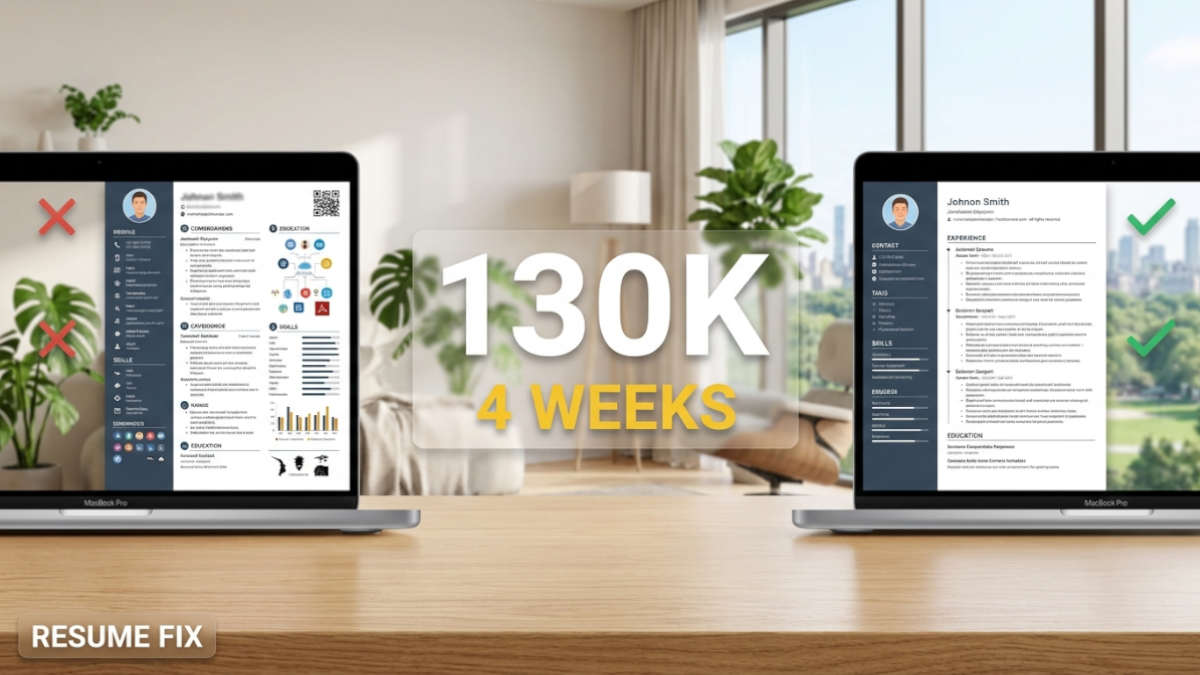
Nick got a 130k job offer using this Resume Guide. Before that? 5 months of job hunting. Lots of ghosting. He was fed up with the market. I told him to try my guide. He did. Then interviews started coming. 4 weeks later, he had 2 offers. He almost gave up.
If you're struggling to get job interviews, grab this GUIDE today. But first, let's talk about why your resume gets skipped.
The job market is brutal right now (here's the data)
Bain & Company released a report in September 2026. It shows job postings fell year over year across major markets, industries, and functions. This is not a small dip. It's a broad slowdown.
Job Postings Decline
Source: Bain & Company Aura℠ Database, September 2026.
Most industries shrank too. Hospitals down 28%. Restaurants down 27%. Financial services down 25%. Retail down 24%. Computer software down 23%. But some stuff grew. AI jobs hit 351,000 postings. Up 60% from last year. Cybersecurity up 19%. Venture capital up 47%. Entry-level roles? Down 11%. That's worse than the 6% drop in Q1. So yeah, the market is tough. Ghosting happens more. Interviews come slower. But Nick still got 2 offers in 4 weeks. How? He fixed his resume.
The ATS reads your resume before a human does
Most companies use software to scan resumes. It's called an ATS. It looks for keywords and simple formatting. Fancy layouts break it. Nick's old resume had columns. Icons. A skill bar graph. The ATS couldn't read it. He switched to one column. Simple headings. Clear text. Then interviews started.
Learn How to Debug Your Brain
Your resume sounds like every other developer
I've reviewed hundreds of developer resumes. Most start with "Passionate developer seeking opportunities." That line says nothing. Nick had that same line. Five months of applications. Ghosting after ghosting. Hiring managers see the same phrases all day. "Team player." "Hard worker." "Fast learner." Those words blend together. You need proof. You need specifics.
You show duties instead of results
"Built REST APIs" is a duty. "Built REST APIs that cut checkout time by 40%" is a result. Managers want outcomes. They want to know what changed because you were there. Nick's resume listed tasks. It read like a job description. The guide helped him flip it. He added numbers. Project impact. User counts. Performance gains. His resume started telling a story.
Your resume has no proof
Proof wins interviews. Proof looks like metrics. "Reduced page load time from 4s to 1.2s." "Led a team of 5." "Shipped 12 features in 6 months." Nick had proof in his work. He just kept it hidden. The guide showed him how to pull it out. How to put it near the top. How to make it easy to scan.
Your resume targets every job
A generic resume gets generic results. Nick sent the same resume to 200+ jobs. He got 2 callbacks. That's a 1% response rate. The guide helped him tailor his resume to each role. He used the same keywords from the job post. He matched the seniority level. He highlighted the right stack. Specificity creates contrast. A tailored resume says, "I read your job post. I know what you need. Here's how I fit." A generic resume says, "I'll take anything."
What I Learned Saying "Yes" to an Unpaid Opportunity
The format fights the reader
Recruiters scan in 6 to 8 seconds. Columns, graphics, icons, and tiny fonts slow them down. Simple format wins. Clear headings. Bullet points. One column. White space. Nick's old resume was two pages. Dense. Hard to scan. The guide helped him cut it to one page. He kept the strongest wins. He removed the noise. Recruiters finally saw his value.
Nick's 4-week turnaround
Nick was close to giving up. I suggested my Resume Guide. He tried it. He started getting interviews. Several interviews. Four weeks later, he had 2 job offers. One paid 130k. He used the same skills he already had. The resume just finally showed them right. That's the power of a resume that works with the ATS, speaks to humans, and proves results. Even in a market where US job postings drop 23% and entry-level roles fall 11%, a strong resume still gets through.
What to fix first
Add numbers to every bullet point.
Match keywords from the job description.
Use a simple, one-column format.
Show results, not duties.
Tailor your resume for each application.
Keep it one page for junior roles. Two pages for senior roles.
Put your strongest proof near the top.
Remove graphics, icons, and skill bars.
Use clear headings: Summary, Skills, Experience, Projects.
Proofread. Then proofread again.
If your resume gets ignored, start here
Your resume gets ignored for a lot of reasons. The market makes it harder. Postings are down. Competition is up. But every reason has a fix. Nick fixed his. He got interviews. He got offers. He got a 130k job. If you're struggling to get job interviews, grab this GUIDE today.