So everyone's talking about CXMT right now. Memory stocks got wrecked this week. Samsung down 7%. SK Hynix down 10%. Micron dropping too.
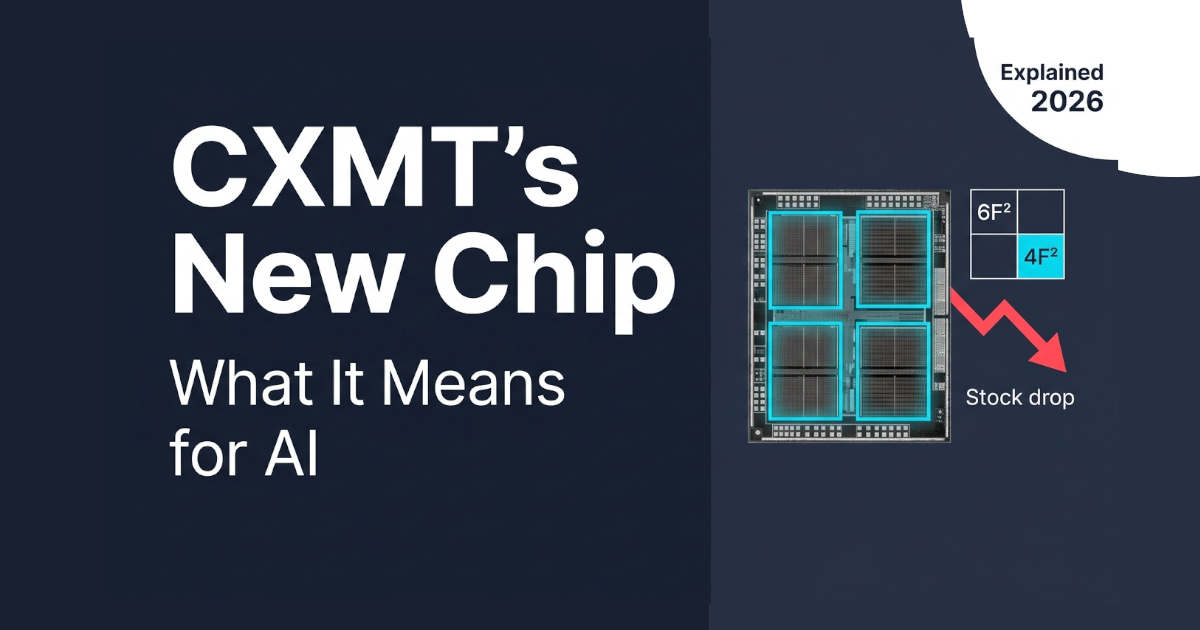
And the reason? A Chinese chipmaker you might not have heard of announced something called "4F²."
Sounds fancy. But is it actually a big deal for AI? Or is everyone just panicking?
Let me break it down.
READ ARTICLE ON "Gates Calls for Global AI Rules & Human Jobs"
What Did CXMT Actually Announce?
Over the weekend, CXMT's president Cao Kanyu spoke at some industry event in Shanghai. He said they made "key progress" on a new memory design called 4F².
The plan? Ship server DDR5 memory using this design by end of 2026.
That's... fast. Maybe too fast.
Here's the deal. Right now, most DRAM uses something called 6F². Moving to 4F² makes each memory cell smaller. Like, about a third smaller.
Smaller cells = more memory in the same space = cheaper per gigabyte. That's the theory anyway.
Every big memory company is working on this. Samsung, SK Hynix, Micron. All of them.
Read article on "What No One Tells You About Real ROI"
Why Should AI Developers Even Care?
Here's the thing. AI eats memory for breakfast.
Training models, running inference, it all needs massive amounts of data moving between processors and memory. Faster memory, denser memory, it all helps.
But wait. There's a catch.
CXMT's 4F² thing is for regular DDR5 server memory. Not the special high-bandwidth memory (HBM) that Nvidia's AI chips actually use.
Big difference. Let me show you:
Memory Type | What It's For | How Much AI Cares |
|---|---|---|
DDR5 RDIMM | Normal servers, databases | Yeah, it matters |
HBM (HBM3E, HBM4) | AI chips (GPUs, TPUs) | This is THE thing |
CXMT is talking about DDR5. Not HBM.
That's important. Like, really important.
Read article on "Skills for AI"
The HBM Gap Is Still Huge
Here's what all those "China beats Samsung" headlines are missing.
CXMT is still way behind in HBM.
We're talking years behind. Like, 3 years at least.
CXMT just started making HBM3E in small amounts. And their yields? Around 25%. That's not great for making money.
Meanwhile, SK Hynix and Samsung are already pumping out HBM3E at scale. They're getting ready for HBM4.
Phillip Wool from Rayliant Global Advisors said it straight:
"We're not even talking about HBM here, and the Korean chipmakers are still unquestionably dominating that space."
So when you see SK Hynix drop 9%... that's probably an overreaction.
Vey-Sern Ling from UBP told CNBC:
"Investors are jittery and looking for excuses to take profit on AI-related stocks that have outperformed this year."
Yeah. That.
So Why Did Memory Stocks Crash So Hard?
Good question. The sell-off wasn't really about CXMT's tech. It was about vibes.
Here's what actually happened:
Korea was catching up: South Korea had a holiday. When trading opened again, they had to price in two days of US chip declines.
Buyback support vanished: Samsung and SK Hynix had this huge $40 billion buyback thing. It ended early. No more safety net.
AI money worries: Intel and Broadcom CEOs both said access to capital could become a problem for AI. If companies can't borrow cheap, they can't buy chips.
CXMT gave them an excuse: The 4F² news was just a reason to sell. Not the real cause.
One analyst put it well: it's "a sign of how vulnerable AI sentiment is at this moment."
What 4F² Actually Means for AI
Let me be real with you.
Short term (2026-2027): Nothing much.
Even if CXMT ships their 4F² DDR5 on time, they got problems:
Server memory needs to run 24/7 without dying
Yields need to be high enough to make money
They're stuck with older DUV equipment (no EUV for them)
Medium term (2027-2028): Prices might drop.
If CXMT can actually make this stuff at scale, DDR5 prices could fall. That hurts Samsung, SK Hynix, Micron. But again, HBM is where the real money is. And CXMT isn't a player there yet.
Long term (2029+): China becomes real competition.
CXMT has been working on 4F² since 2016. They have 300+ patent families. That's not nothing.
Elon Musk said something about this:
"When China figures out how to manufacture a product, their ability to scale is often greater than the rest of the world combined."
If CXMT cracks mass production? The whole DRAM game changes. But we're not there yet. Not even close.
text
CXMT 4F² DDR5:        Q4 2026 (they say)
Samsung 4F²:          ~2028 (guessing)
SK Hynix 4F²:         2025 (showed plans, no product)
These are announced plans, not confirmed shipping dates.
The Real Story Here
If you remember one thing, remember this:
The market is scared of AI right now.
Not because AI demand is dropping. It's not. JPMorgan says AI stocks will drive Asian markets through 2027.
But investors are asking harder questions:
Can AI companies actually make money?
How long can memory makers keep prices high?
What happens when China catches up?
CXMT's announcement didn't answer those questions. It just made everyone remember they exist.
FAQ
Is CXMT's 4F² chip actually out yet?
No. They say end of 2026. But saying and doing are different things.
Does this hurt Nvidia?
Not really. Nvidia uses HBM. CXMT is still far behind in HBM.
Why did memory stocks drop so much then?
Markets panic. Investors wanted a reason to sell. CXMT gave them one. That's it.
Should I worry about memory prices going up?
Short term? Probably not. If CXMT scales up, DDR5 prices could actually drop. HBM is different, still tight supply there.
What should I watch next?
CXMT's actual product. If they ship 4F² DDR5 in volume, that's real news. If it's delayed or yields are bad? Marketing fluff.
Final Takeaway
CXMT's 4F² progress is legit. China can innovate in memory. Not just copy stuff.
But for AI? Immediate impact is small. The HBM market is still owned by Samsung, SK Hynix, and Micron. CXMT is chasing. That gap won't close overnight.
What this really showed us is how nervous AI investors are. One technical announcement from a Chinese challenger wiped out $100 billion in memory market value.
That's wild.
The tech matters. But right now? Psychology matters more.