Every year, the same question pops up in coding forums, Discord servers, and YouTube comments:
"Is Node.js still worth learning, or am I wasting my time?"
I get it. You're a beginner. You don't want to spend months learning something that might be obsolete by the time you're job-ready. You've seen the headlines about Bun being faster, Deno being more secure, and AI writing code for you.
So let's settle this once and for all.
Here's the short answer: Yes, beginners should still learn Node.js in 2026.
But the way you learn it matters more than ever. Let me show you exactly why.
The Numbers Don't Lie: Node.js Is Huge
Before we talk about opinions, let's look at facts.
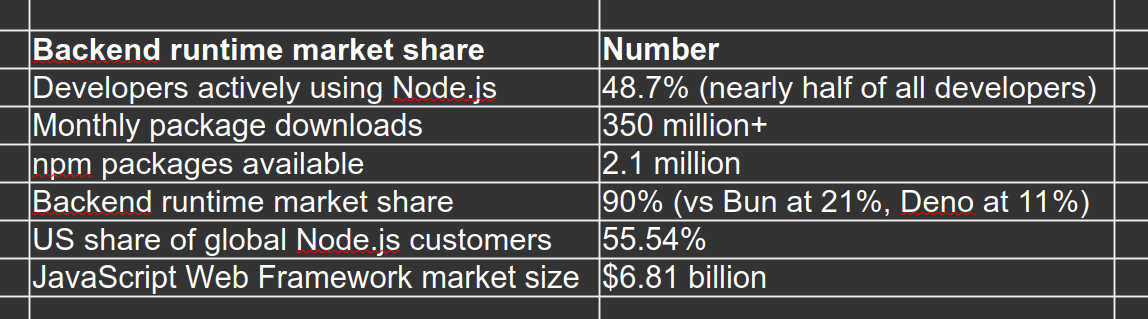
Node.js isn't just popular. It's the #1 runtime framework in the world.
Let that sink in.
Almost half of all softwa
re developers worldwide use Node.js. It's not going anywhere.
What Beginners Actually Want to Know
Let me address the elephant in the room.
Beginners aren't asking "Is Node.js good for enterprise microservices?" They're asking:
"Can I get a job with this?"
"Is it hard to learn?"
"Will AI replace me if I learn this?"
"Should I learn Bun or Deno instead?"
Let's answer each one honestly.
Question 1: Can I Get a Job with Node.js?
Short answer: Yes.
Companies are still hiring Node.js developers everywhere. Here's what the job market looks like:
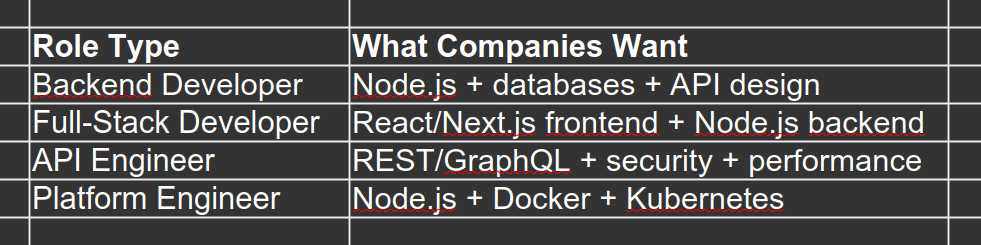
The demand isn't slowing down. 116,000 companies with fewer than 10 employees use Node.js. 26,246 companies with 100–249 employees use it too.
From tiny startups to Netflix, PayPal, and LinkedIn, Node.js runs production systems everywhere.
My verdict: If you're worried about job opportunities, worry about something else. Node.js skills are still in high demand.
Question 2: Is Node.js Hard to Learn?
Here's where Node.js shines for beginners.
If you already know JavaScript (or are learning it), Node.js feels natural. You're not learning a completely new language. You're learning how to use JavaScript on a server.
Compare this to:
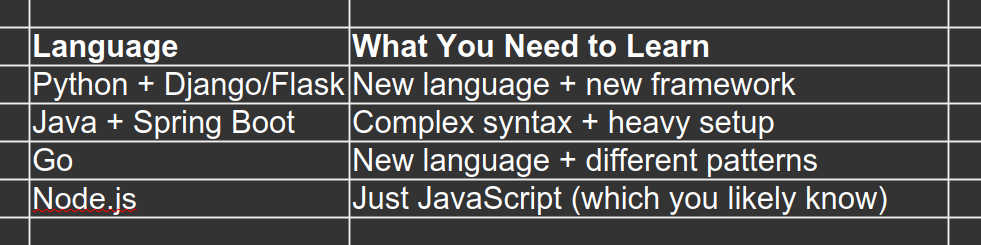
The learning curve is gentler because JavaScript is everywhere. You probably already know some of it from frontend tutorials.
Plus, the community is massive. Stuck on a problem? Someone on Stack Overflow has already solved it. The documentation is mature. Tutorials are everywhere.
My verdict: For a beginner, Node.js is one of the easiest backend paths to start.
Question 3: Will AI Replace Node.js Developers?
This is the fear every beginner has in 2026.
Let me be honest: AI has changed things. AI tools like GitHub Copilot, ChatGPT, and Cursor can now:
Generate boilerplate code
Create basic APIs
Write tests
Explain concepts
But here's what AI cannot do:
Design scalable system architecture
Understand business requirements deeply
Debug complex production issues
Make smart tradeoffs between performance, cost, and maintainability
Take responsibility when things break
The article from the industry makes a powerful point:
"As AI automates routine coding tasks, deeper technical understanding becomes increasingly important."
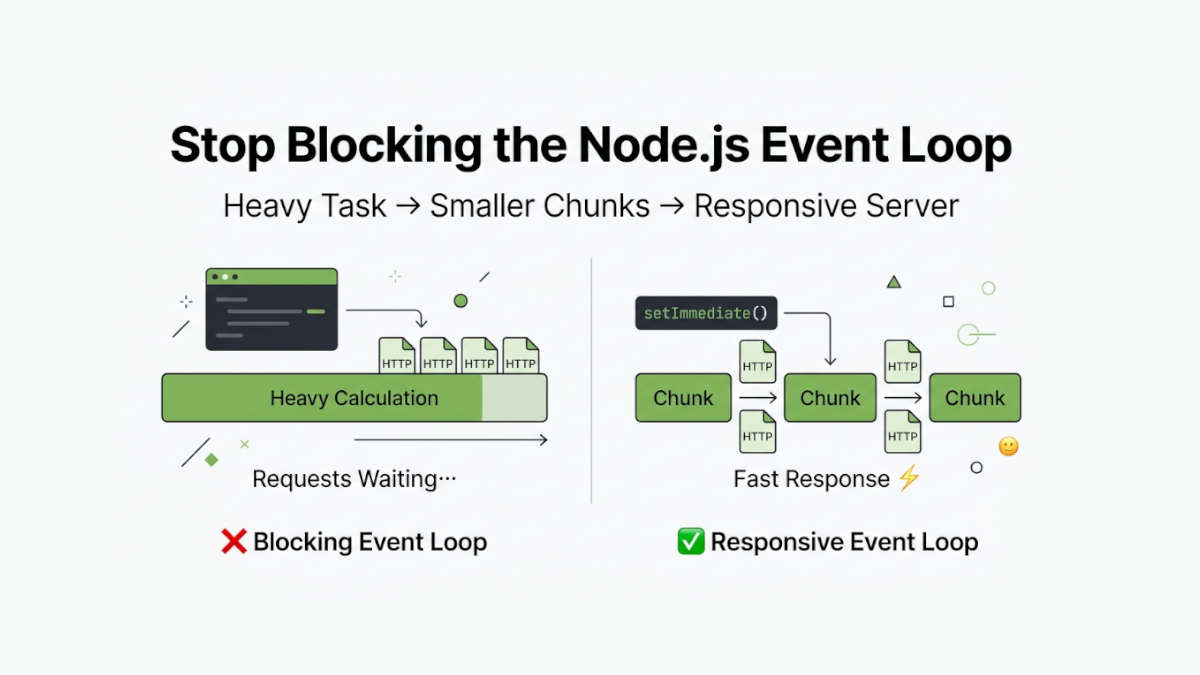
This means beginners who only learn "how to write Express.js routes" will struggle. But beginners who understand how Node.js actually works — the event loop, streams, buffers, concurrency — will be more valuable than ever.
My verdict: AI won't replace you if you learn the internals, not just the surface.
Question 4: Should I Learn Bun or Deno Instead?
Ah, the shiny new tools question.
Let's look at the real comparison:

Yes, Bun is faster. Yes, Deno is more modern.
But here's what the numbers don't show:
Node.js has 2.1 million npm packages that work perfectly
Every major cloud provider natively supports Node.js
Hiring managers know Node.js — they may not know Bun
90% of JavaScript backends still run on Node.js
For a beginner, choosing Bun over Node.js is like learning to drive a Formula 1 car before learning how traffic rules work. Sure, it's faster. But you won't find many employers asking for it.
My verdict: Learn Node.js first. Bun and Deno are worth knowing later.
What Beginners Should Actually Learn in 2026
Here's the thing: Learning Node.js in 2026 isn't just about npm install express.
The beginner journey should look different now. Here's what I'd recommend:
Phase 1: JavaScript Fundamentals (Month 1)
Variables, functions, arrays, objects
Callbacks, promises, async/await
ES6+ syntax (arrow functions, destructuring, template literals)
Phase 2: Core Node.js Concepts (Month 2)
What Node.js actually is (a runtime, not a language)
How the event loop works
Modules and requiring files
File system operations
Basic HTTP server without frameworks
Phase 3: Express.js or NestJS (Month 3)
REST API design
Middleware
Routing
Connecting to databases (MongoDB or PostgreSQL)
Authentication basics (JWT, sessions)
Phase 4: Real-World Skills (Month 4-6)
TypeScript (yes, even for beginners in 2026)
Docker basics
Deploying to a cloud platform
Testing with Jest
Git and GitHub workflows
Phase 5: Advanced Topics (Ongoing)
Microservices architecture
Redis for caching
WebSockets for real-time apps
Performance optimization
Security best practices
The TypeScript Question
Here's something many beginners miss.
In 2026, TypeScript adoption in professional Node.js environments has crossed 70%. Over 40% of developers write exclusively in TypeScript.
What does this mean for you?
It means learning TypeScript early will give you a huge advantage. Companies don't just want JavaScript anymore. They want type safety, better IDE support, and fewer runtime bugs.
The good news? Node.js 24 (released in late 2025) has native TypeScript support. You don't even need extra setup anymore.
What Real Companies Care About
Let me paint a picture of what a typical Node.js job interview looks like in 2026:
Basic questions (every candidate should answer):
What is the event loop?
How do promises work under the hood?
What's the difference between
letandvar?Write a simple Express route.
Intermediate questions (what gets you hired):
How would you handle 10,000 concurrent connections?
What happens when the event loop is blocked?
How do you secure a REST API?
Explain how caching works and when you'd use it.
Advanced questions (for senior roles):
Design a microservices architecture for a food delivery app.
How do you debug memory leaks in production?
When would you choose Node.js over Go or Java?
Explain the tradeoffs between SQL and NoSQL.
Notice something? The advanced questions aren't about Node.js syntax. They're about engineering thinking.
The Skills That Actually Matter
Here's a truth that might sting a little: knowing Node.js alone won't get you hired anymore.
Companies in 2026 expect more. They want developers who understand the full picture, not just how to write a few routes. I call this the Node.js Developer Stack of 2026 — and here's what it looks like.
First, you need core Node.js concepts like the event loop, streams, and buffers. Interviewers test this constantly, and most beginners skip it. Don't be that person.
Next up is TypeScript. Over 70% of professional codebases use it. Learn types, interfaces, and generics — it will make you stand out immediately.
Then comes databases. PostgreSQL for relational data, MongoDB for flexible documents, and Redis for caching. You don't need to master all three, but understand when to use each one.
API development is where you'll spend most of your time. REST is still the standard, but GraphQL is growing fast. Learn clean endpoint design and proper error handling.
Testing separates hobbyists from professionals. Companies won't ship untested code. Learn Jest and write unit tests — it's what gets you hired.
You also need cloud basics. Most apps deploy to AWS, Azure, or Google Cloud. Know how to deploy a simple app and understand what serverless means.
Docker is standard practice now. Spend a weekend learning containers and docker-compose. It pays off immediately.
Finally, security. JWT authentication, OAuth flows, input validation. Security breaches kill companies, and they'll kill your career too if you're responsible for one.
Do you need all of this on day one? No.
But this is where you're heading. Start with core Node.js and databases. Add TypeScript once you're comfortable. Pick up testing and Docker as you build real projects. Security and cloud knowledge will come naturally as you deploy applications.
The key is understanding that Node.js is just the foundation. The more layers you add, the more valuable you become.
My Honest View: Should You Learn Node.js as a Beginner?
After reading all these articles and statistics, here's my genuine take:
Yes, you should learn Node.js in 2026. But not because it's the "best" technology. Learn it because it's the most practical choice.
Here's why:
1. The job market is still strong
Half of all developers use Node.js. Companies are hiring. Remote jobs are plentiful. The demand isn't going away in the next 5 years.
2. JavaScript is a safe investment
Even if you later switch to Python, Go, or Rust, JavaScript skills transfer. The concepts you learn — async programming, APIs, databases — apply everywhere.
3. The ecosystem is unmatched
2.1 million npm packages. Every cloud provider supports it. Every problem has a solution. For a beginner, this safety net is invaluable.
4. Community support is massive
Stuck? Someone has the answer. Learning resources are abundant. Forums are active. You'll never feel alone.
5. Full-stack development is easier
If you learn Node.js, you're already halfway to full-stack development with React, Next.js, or Vue. One language, both sides.
What I Would Do If I Were Starting Today
Here's my step-by-step plan if I were a complete beginner in 2026:
Month 1: Learn JavaScript deeply
Don't touch Node.js yet. Master JavaScript first. Focus on:
Functions and callbacks
Promises and async/await (critical for Node.js)
Array methods
Basic DOM (just enough to understand frontend)
Resource: FreeCodeCamp, The Odin Project, or JavaScript.info
Month 2: Understand Node.js fundamentals
Install Node.js
Run your first script
Learn the event loop (watch talks, read articles)
Build a simple HTTP server without Express
Understand modules, require/import
Resource: Node.js official docs + YouTube tutorials
Month 3: Build with Express.js
Create REST APIs
Connect to MongoDB (easy for beginners)
Add authentication (JWT)
Deploy to a free platform (Render, Railway, Vercel)
Resource: Any modern Express tutorial (2025 or later)
Month 4: Learn TypeScript
Add TypeScript to an existing project
Learn types, interfaces, unions
Understand why companies love it
Resource: TypeScript official handbook
Month 5-6: Build real projects
Build 3-4 projects that show real skills:
Task Management API (CRUD + authentication)
Real-time Chat App (WebSockets)
E-commerce API (products, cart, orders)
Blog Platform (Markdown, file uploads)
Push everything to GitHub. Deploy everything. This becomes your portfolio.
Month 7+: Apply for jobs
With 6 months of focused learning and a portfolio of real projects, you're ready for junior roles.
What NOT to Do
Don't Do This:
Jump between frameworks constantly
Only watch tutorials
Ignore TypeScript
Skip the fundamentals
Wait until you "feel ready" to apply
Learn 5 languages simultaneously
Do This Instead:
Master one thing first (Express or NestJS)
Build projects alongside learning
Start learning TypeScript by month 3-4
Learn event loop and async deeply
Start applying after 3-4 solid projects
Master JavaScript + Node.js first
The Bottom Line
Node.js in 2026 isn't the "hot new thing" anymore. It's something better: it's proven, stable, and everywhere.
Beginners should learn Node.js because:
Jobs are plentiful (48.7% of developers use it)
Learning curve is gentler (JavaScript everywhere)
Ecosystem is massive (2.1 million packages)
Community is supportive (millions of developers)
Future is secure (LTS support through 2028 and beyond)
The articles I've read all point to the same conclusion: Node.js isn't dying. It's evolving. The developers who succeed in 2026 and beyond are those who understand how Node.js works, not just what to type.
So yes, learn Node.js. But learn it deeply. Build things. Understand the why, not just the how.
That's how you turn a beginner skill into a career.