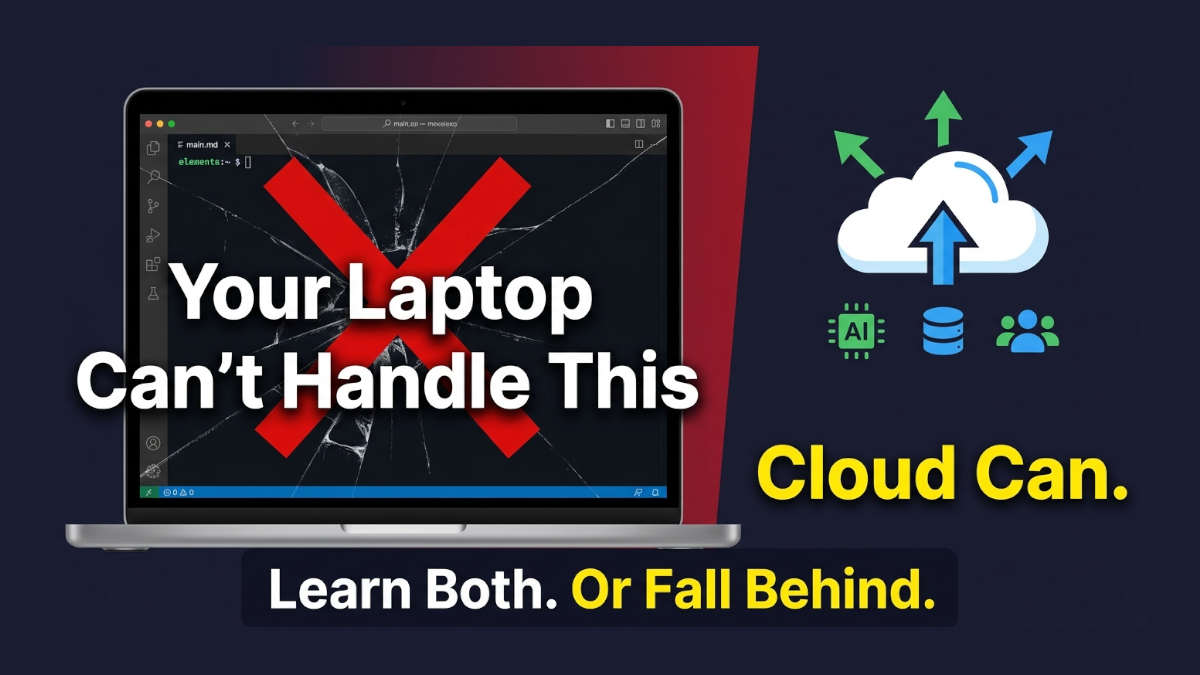
Want to fall behind in tech in 2026? Ignore cloud computing.
Sounds dramatic, right? But honestly, it's not far off.
AI, websites, apps, even the tools you use every day. A lot of them run on cloud infrastructure. That's just how things work now.
But here's the twist. AI makes mistakes. Cloud systems fail. Costs can go crazy. And if you don't understand the cloud, fixing any of that gets way harder than it should be.
Imagine your AI app suddenly gets ten thousand users overnight. Can your laptop handle that? Probably not. Cloud computing helps your app scale when demand grows. But scaling without knowing what you're scaling into? That's how people wake up to bills they can't explain and outages they can't debug.
So here's the real question for 2026. Cloud, AI, or both?
Me? I'd learn how they work together.
Don't just build apps. Learn how to run them. Scale them. Keep them alive.
Let me break down why this matters more than ever.
Read article on: How to Migrate from Deno Deploy to Cloudflare Workers
Cloud Is Not Optional Anymore
There was a time when "learn to code" was enough. You built something on your laptop, pushed it somewhere, hoped it worked. That time is gone.
Cloud is now where software lives. It's not some fancy skill only DevOps people need. It's the ground your code runs on. Whether you like it or not.
The data backs this up. Researchers looked at over 15,000 open tech roles across more than 1,000 companies in 2026. After Python, the most wanted skill wasn't another language. It was the cloud. AWS showed up in one out of every four jobs. Kubernetes in one out of five. More job posts asked for Kubernetes than React, Java, TypeScript, or Go. Of the twelve most requested skills, six were cloud and infra stuff: AWS, Kubernetes, Google Cloud, Docker, Azure, and Terraform.
And here's the part that surprises people. Only about one in thirteen of those jobs was a dedicated infra role. The rest were normal backend, full-stack, and data jobs. They just expect you to ship code into a container on a cluster in someone else's cloud.
So if you're a dev in 2026 and you've never touched the cloud? You're not missing a bonus skill. You're missing the floor you're standing on.
Read article on: Skills for AI
The AI Illusion: "The Model Works" Isn't Enough
Let's talk about AI, because this is where the gap gets dangerous.
You can build an AI app on your laptop. Run a model locally. Test it with a few inputs. Feel like you figured it out.
But that's not an app. That's a demo.
The moment real users touch it, everything changes. Requests pile up. Memory spikes. Latency becomes visible. And if you've never dealt with cloud infra, you have no idea where the bottleneck is or how to fix it.
The stats make this real. AI workloads made up 19% of enterprise cloud spending in 2026. That's up from 8% in 2023. And for the first time, inference workloads used more compute than training. That means most AI spending isn't happening in research labs. It's happening in production systems serving real users.
If you don't understand how those systems are deployed, monitored, and scaled? You're building on a foundation you can't see.
"The value was never in typing the commands, because the agent types faster than you. The value is being the one who looks at the plan and knows this token is scoped too wide, or that line is going to take the site down.", Analysis of AI coding agent failures in 2026
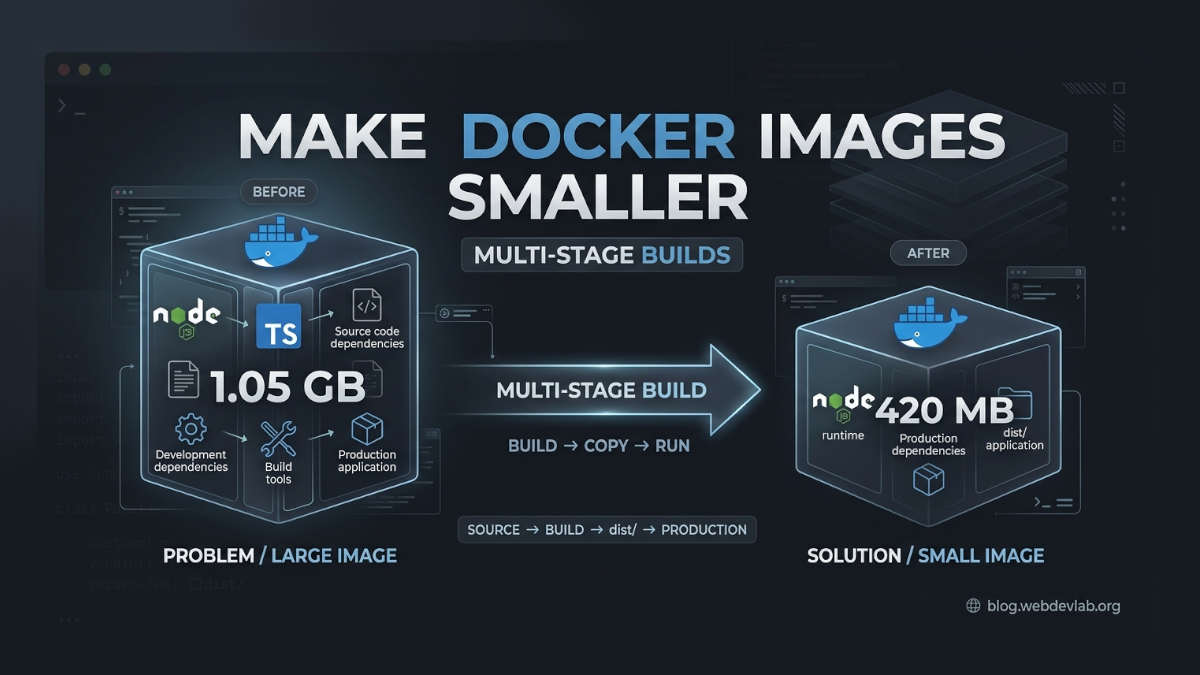
Read article on: How to Reduce Docker Image Size
Scaling Isn't Magic: What Actually Happens When Users Show Up
The script asks a simple question. If your AI app gets ten thousand users overnight, can your laptop handle it?
No. And no amount of clever code changes that.
Scaling sounds abstract until it isn't. On a laptop, your app runs as one process. Everything shares the same CPU, memory, and disk. When demand goes up, you have two options. Wait for things to slow down. Or buy a bigger laptop.
Cloud changes the equation. Instead of one big machine, you run multiple smaller ones. Instead of fixed memory, you provision what you need and release it when demand drops.
But here's the catch. Horizontal scaling doesn't just happen because you deployed to a cloud provider. You have to design for it. You have to think about stateless services, load balancing, and where session data actually lives. You have to understand why a database connection pool matters when fifty instances are trying to connect at once.
That's why learning cloud isn't just about learning a provider's console. It's about learning how distributed systems think. And that only makes sense when you've felt the pain of getting it wrong.
Microsoft's own architecture guidance puts it plainly. Design apps to dynamically allocate and release resources to meet performance needs and minimize cost. That's the whole game. Not just making it work. Making it work efficiently as demand changes.
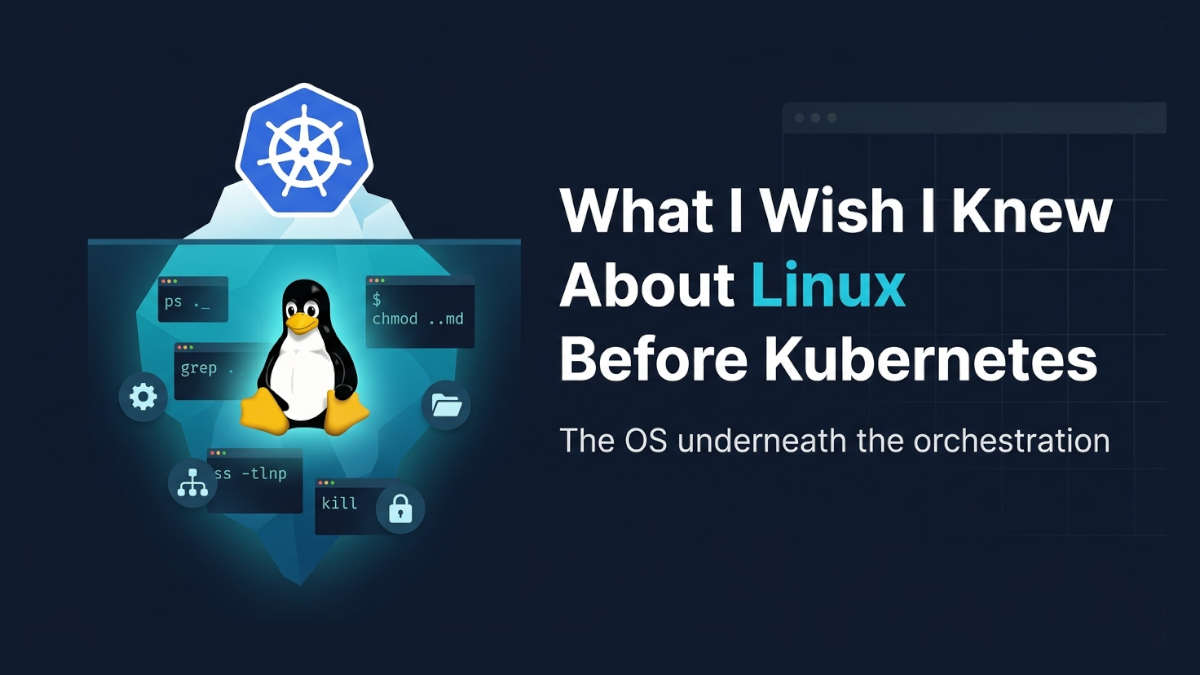
Read article on: Learn Linux Before Learning Kubernetes
Cloud Failures Are Real (And Usually Human)
The script mentions cloud systems can fail. True. But the more useful truth? Most cloud failures aren't mysterious. They're config mistakes, permission errors, and assumptions that didn't survive production.
The Cloud Security Alliance surveyed over 500 IT and security pros in 2026. 65% had at least one business-critical app outage caused by a misconfigured security policy in the past year. Another 46% reported two or more outages. Nearly 40% said fixing it took four days or longer.
Read that again. Two-thirds of orgs had an outage because someone configured something wrong. Not because of some fancy attack. Not because of a zero-day. Because a policy was too broad, a permission was too open, or a rule hit the wrong resource.
And the kicker. 92% said it was hard to get one accurate view of security policies across their cloud environments. Only 9% had security policy management fully baked into their dev workflows.
This is what happens when teams adopt cloud without understanding it. The tools are powerful. But power without understanding is just a faster way to break things.
A dev who knows cloud basics would catch that overly broad IAM role before it goes live. They'd notice the public storage bucket. They'd ask why a production database is reachable from the open internet. These aren't advanced security skills. They're baseline cloud literacy.
Read article on: TDD Workflow
Cloud Costs: The Silent Failure Mode
If outages are the loud failures, cost overruns are the quiet ones. And they're getting worse.
Flexera's 2026 State of the Cloud report said 29% of cloud spend is wasted. Up from 27% the year before. That ended a five-year trend of waste going down. The report blamed AI workloads mostly. They eat compute in weird, hard-to-predict bursts that old budgeting habits weren't built for.
17% of orgs blew past their public cloud budget last year. And 98% of FinOps teams now track AI spend. That's up from just 31% in 2024. Costs are getting harder to predict. Companies are scrambling to catch up.
But the stats don't capture the individual panic. In July 2026, AWS customers got cost estimates showing billions. Sometimes trillions. One user who normally spent $0.19 a month saw an estimate of $2.4 billion. Another saw a warning that they owed over $428 billion for half a month of usage. It was a software bug, and AWS confirmed it. But for a few hours, devs were staring at dashboards that looked like financial ruin.
The point isn't that AWS is broken. The point is this. If you don't understand how cloud pricing works, you can't tell the difference between a bug and a disaster. You can't look at a bill and know if it makes sense. You can't design an architecture that keeps costs predictable.
Understanding cloud costs isn't about becoming a finance person. It's about knowing which services charge per request, per hour, or per data transfer between regions. It's about looking at a proposed architecture and saying, "That's gonna be expensive, and here's why."
"In 2026, 'it works' isn't good enough. 'It's efficient' is the goal. An engineer who can cut a cloud bill by 30% is more valuable than one who just adds more EC2 instances.", Cloud skills analysis, 2026
So What? Cloud, AI, or Both?
The script asks this directly. Worth answering honestly.
You don't have to choose. In fact, picking one without the other is a false economy.
AI without cloud knowledge means you can train a model but can't serve it reliably. You can write inference code but can't scale it, monitor it, or keep it from costing five figures a month. You're dependent on someone else to make your work actually usable.
Cloud without AI knowledge means you can manage infra but you're missing the workload driving most of the new demand. AI workloads have the messiest scaling needs, the most unpredictable costs, and the highest stakes when they fail.
The devs who'll be most valuable in 2026 and beyond? The ones who get both. Not as separate silos. As layers of the same system. They know how a model gets deployed. They know why inference latency matters for user experience. They know how to configure autoscaling for a workload that spikes unpredictably.
F5's 2026 research found 78% of orgs are running AI inference in production. Average of seven models running at once. Someone has to deploy those models, monitor them, and keep them alive. That someone needs to understand both the AI and the cloud.
What to Actually Learn (In Order)
Convinced but not sure where to start? Here's a practical path.
First, learn cloud basics. Pick one, AWS, Azure, or GCP, and learn the core services. Not everything. Just the fundamentals: compute, storage, networking, and identity. You don't need certs. You need to be able to spin up a server, put something on it, and reach it from the internet.
Second, learn how deployment works. Understand what a container is and why it matters. Learn basic Docker. Then learn enough Kubernetes to understand what it's doing, even if you don't become an expert. Most cloud job listings expect some container experience.
Third, learn Infrastructure as Code. Terraform or similar. Why? Because clicking through a console isn't reproducible. If you can't describe your infra in a file, you can't review it, version it, or recover it reliably. Employers increasingly expect automation, not manual management.
Fourth, learn how AI workloads differ. Understand inference versus training. Learn why inference is often more expensive at scale. Learn how to monitor latency and token usage. Learn what happens when your model starts producing garbage and you need to roll back.
Fifth, build something and break it. Deploy a small AI-powered app. Give it a public endpoint. Watch what happens when traffic hits it. Then break something on purpose, a permission, a network rule, and see how the failure shows up. That lesson sticks in a way no tutorial can copy.
Common Mistakes to Avoid
Don't treat cloud as someone else's problem. The most expensive outages happen because the person who built the app didn't understand the environment it ran in. You don't need to be a cloud architect. But you need to know enough to ask the right questions.
Don't ignore cost until the bill arrives. Set up billing alerts on day one. Understand what your architecture costs per hour. A dev who can predict costs is worth more than one who just adds instances until the graph goes up.
Don't assume "managed" means "safe." A managed database still has permissions. A managed queue still has access policies. A managed AI service still has API keys that can leak. The provider manages the hardware. You manage everything on top of it.
Don't skip the basics to chase the shiny stuff. It's tempting to jump straight into serverless AI pipelines and agentic workflows. But if you don't understand networking, IAM, and basic compute, the advanced stuff will break in ways you can't diagnose.
Don't learn in isolation. The cloud is a shared environment. What you do affects other services, other teams, and other budgets. Learn with that in mind.
Key Takeaways
Cloud is the default, not the exception. AWS, Kubernetes, and Terraform show up in more job listings than most programming languages.
AI runs on cloud infra. Inference workloads now use more compute than training. Most orgs run multiple models in production.
Misconfigurations cause most cloud outages. 65% of orgs had a business-critical outage from a security policy mistake last year.
Cloud waste is rising. 29% of cloud spend is wasted, driven partly by unpredictable AI workloads.
You don't have to choose between AI and cloud. The most valuable devs get how they fit together, deploying, scaling, and monitoring AI in real environments.