SvelteKit 3 dropped on October 1, 2026.
If you're planning to upgrade, there's one thing you should know before you touch anything.
This isn't just a framework update. It's a stack update.
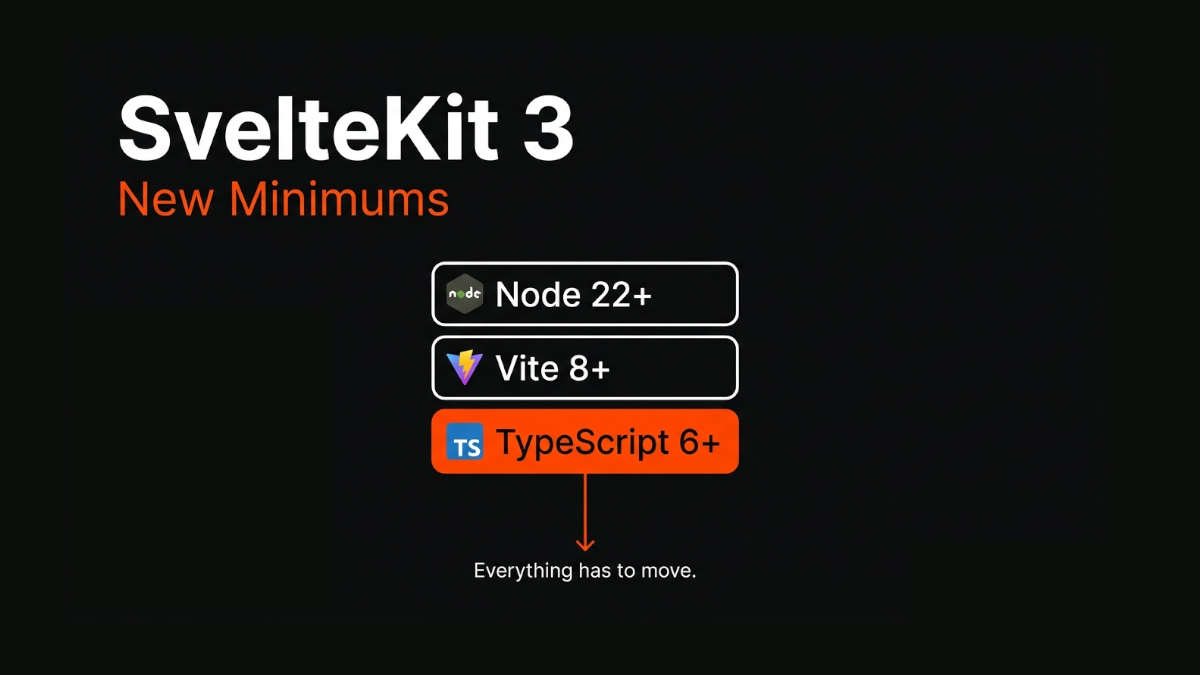
SvelteKit 3 needs newer versions of the stuff under it. Node 22. Vite 8. TypeScript 6. If you're running older versions, your upgrade just won't work. Not until you fix those first.
So let's go through what actually changed, and what it means for your project.
The New Minimums
Here's the list. These aren't suggestions. They're required.
Tool | Minimum | What it's for |
|---|---|---|
Node | 22+ | Runs your server |
TypeScript | 6+ | Type checking, editor stuff |
Vite | 8.0.12+ | Build tool |
Svelte | 5.56.4+ | The UI framework |
Svelte Vite Plugin | 7 | Hooks Svelte into Vite |
Vite 8.0.12 is the important one. It's the first Vite 8 release with Rolldown 1.0.0 baked in as stable. Rolldown is a bundler written in Rust. It replaces the old Rollup pipeline. That's where a lot of the "SvelteKit 3 is faster" talk comes from.
Not SvelteKit itself. Vite + Rolldown.
Why This Is More Than a Version Bump
Here's the part most upgrade posts skip.
Changing one line in package.json? Easy. Everything else that has to move with it? Not easy.
Think about it.
If your app runs on Node 18, you can't just upgrade SvelteKit. You gotta upgrade Node on:
your laptop
your CI
your build servers
your Docker images
That's four different places. Four different owners. Four different test runs.
Now add custom adapters. Add old TypeScript configs. Add hosting setups.
It adds up fast.
Someone over at WebPulse put it well:
"A framework release is free to download. The bill arrives when the stack beneath it has to move."
Yeah. That's the whole thing in one sentence.
Breaking Change #1: Adapters Need Work
If you use a third-party adapter like adapter-netlify, adapter-vercel, or adapter-node — check that they've shipped a SvelteKit 3 version first.
If you wrote your own adapter? You're doing the work yourself.
Two things broke:
createEntrieswas removed from the builder objectbuilder.generateManifestgot replaced by two new members
That's how your adapter tells SvelteKit which routes exist and how to build the manifest. So it's not a small thing.
Quick tip: ask your team which adapters are in use. Then check the GitHub for a v3 release. Don't assume it'll just work.
Breaking Change #2: $lib Is Now #lib
Everyone's talking about this one.
Old way:
import { formatDate } from '$lib/utils';New way:
import { formatDate } from '#lib/utils/index.ts';Yeah. $lib is gone. It's #lib now.
Why though?
$lib was a SvelteKit-only thing. Vite and TypeScript both had to agree on it. Messy.
#lib uses Node's native subpath imports. You declare it in package.json. Now it works in more places — including server code you might want to run without SvelteKit.
The annoying part
#lib needs file extensions. So this won't work:
import { formatDate } from '#lib/utils'; // nopeYou need:
import { formatDate } from '#lib/utils/index.ts'; // yesIf your build blows up with a module resolution error after upgrading, that's probably why. Go look for #lib imports pointing to folders, or missing the extension.
What Rich Harris said
The maintainer was pretty honest about this one. In the original GitHub issue he said he'd "love for everyone to use nodenext" but that "users might revolt" over extensionless imports.
And if you really don't like it? "You can always create your own alias."
Fair enough.
The migration tool rewrites most of these for you. But it won't catch everything.
Breaking Change #3: Config Moves to vite.config.ts
SvelteKit 2 had svelte.config.js. That file's gone.
Now it all lives in vite.config.ts.
Why? Because the Vite plugin can read it right away. Synchronously. No waiting around. In SvelteKit 2, config resolution was async — it couldn't even start until the full Vite config was resolved. Slow and awkward.
That's fixed now.
What it means for you:
Migration tool moves your config automatically
Vite plugins can read SvelteKit config directly
vite.config.tsis now the one place for config
One file. Nice.
What to Know Before Learning Next.js in 2026: A Practical Guide
Breaking Change #4: Security Defaults Flipped
SvelteKit 3 turns a few security things on by default. They used to be opt-in.
Short version:
Thing | Before | Now |
|---|---|---|
External redirects | Allowed | Blocked |
Cookie path | Not set |
|
CSRF check |
|
|
| Allowed | Rejected |
The idea is simple. The framework says no first. Want the old behavior? You have to say so in your config.
What this breaks in real life
Say you redirect users to a partner site after login. That worked before. Now it's blocked until you allow it.
Or say your app accepts form posts from a subdomain. Also blocked now. You need to add that origin to trustedOrigins.
Do this: test every flow that
redirects somewhere else
accepts form posts from another origin
sets cookies
If something breaks, now you know why.
Breaking Change #5: Ops Stuff
A few things changed for deployment, not code.
kit.paths.originreplaces theORIGINenv var inadapter-nodeversion.pollIntervalnow defaults to 1 hour$service-workeris gone — use$app/env,$app/paths, and$app/manifest
If your ops team depends on any of these, they need a heads-up.
How to Actually Migrate
Here's the command:
npx sv migrate sveltekit-3 --tasks all --confirmIt does a lot:
rewrites
$lib→#libmoves config to
vite.config.tsupdates
tsconfig.jsongives you a TODO list for anything it can't do
Your checklist
Check versions.
node -v,npx tsc -v, and yourpackage.jsonfor Vite.Bump Node to 22+ everywhere. Local, CI, servers, Docker.
Bump TypeScript to 6+.
Bump Vite to 8.0.12+.
Bump Svelte to 5.56.4+ and the Vite plugin to 7.
Run the migration command.
Fix
#libimports that point to folders or lack extensions.Test redirects, cookies, cross-origin forms.
Check your adapters.
Read the full release notes on GitHub. The published list cuts off early.
The Svelte team said it themselves:
"We've made migration as seamless as we can... which will automatically migrate as much of your codebase as possible, and generate a TODO list for everything else."
Translation: it does most of it. You do the rest.
Remote Functions? Not Yet
If you saw "remote functions" and got excited — hold on.
They're not ready. Still behind an experimental flag. Still need Async Svelte.
Team says it's their top priority. But it's not shipping today.
So if remote functions are why you want to upgrade, wait a bit.
Should You Upgrade Right Now?
Depends.
Yeah, go for it if:
You're already on Node 22+ and Vite 8
No custom adapters
You have time to test redirects and forms
You want faster Rolldown builds
Hang on if:
You're on Node 18 or 20 and can't move yet
Your custom adapter isn't updated
You lean hard on external redirects and can't test right now
SvelteKit 2 still works. There's no emergency. But if your stack's ready, SvelteKit 3 is a good upgrade. Faster builds. Better types. Less junk.